
December 2, 2025·Sports
Why the WNBA labor strike is the most important story in America right now
Dion Rabouin·article
Originally published on LinkedIn here. Republished with permission from the author.
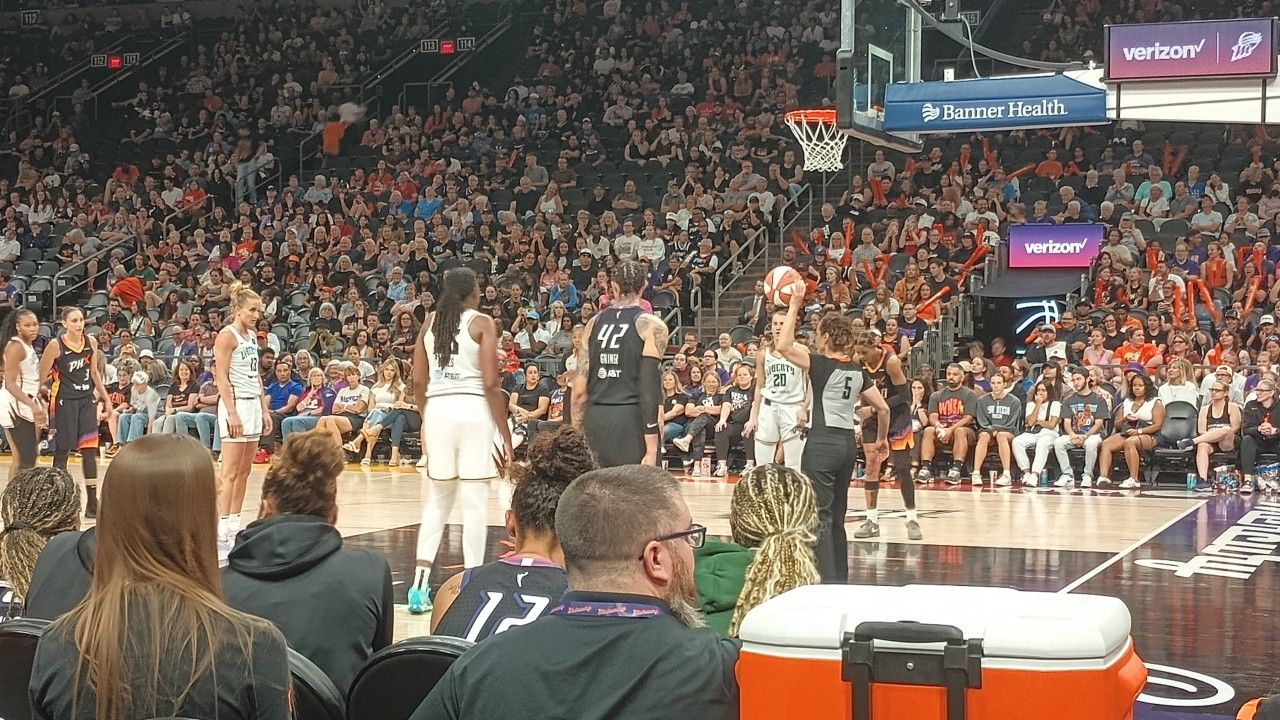
A shot from behind the home team's bench at the Phoenix Mercury vs New York Liberty game. Photo credit: Me.
The impending WNBA labor strike or ownership lockout (whichever happens first) is the most consequential story in America right now, and maybe the world. I will tell you why.
There is a massive public relations war happening between labor and ownership, and both sides see the WNBA as the next major battlefront. Add to that the growing popularity and power of women’s sports and female athletes, plus the absolutely irrational momentum of sports franchise valuations, and you have a story that touches politics, sports, business, markets, the economy, entertainment, social media, and everything in between.
Here’s where we are: The 2025 WNBA season was by far the most popular and profitable the league has ever seen, but from an asset valuation standpoint (the asset being the value of the WNBA), it was unlike anything we have ever seen. The valuations on WNBA franchises were already absurd going into the season and have gone to a level that I can only describe as stupefying.
The Connecticut Sun, a middle-of-the-road franchise that plays in Uncasville, Connecticut, is the smallest market in the league, and is solely owned by a Native American tribe, received an offer that valued the franchise at $350 million. That doesn’t seem that crazy until you realize that in June, Forbes valued the franchise at $200 million. So, you’re looking at a 75% increase in value in a matter of three months.
Not only that, WNBA franchises are already receiving the highest multiple of all sports franchises—by a lot. For the 2024 season, Forbes reported the Sun generated revenue of $14 million. So, if the $350 million valuation goes through, the Sun would be selling at a multiple of 25 times revenue. (Yes, I’m using 2024 revenue numbers and comparing them to a 2025 valuation, but just go with me on this.) That. Is. Insane.
For context, the last NFL team to be sold, the Washington Commanders, sold for $6 billion at a revenue multiple of 11, and the last NBA franchise sold fetched a multiple of just under 9 times revenue.
That means the smallest-market team in the WNBA would be valued at a revenue multiple twice as high as the highest valued NFL team ever and three times the highest value of an NBA team ever recorded.
Quick explainer for those who aren’t super familiar with revenue multiples: The higher the multiple, the more value an investor believes an asset will deliver in the future. This is why tech companies generally have higher multiples than manufacturing companies or banks or retailers, because technology companies are seen as more likely to increase exponentially in value. Multiples aren’t based on anything except how much investors are willing to pay for a share of a company’s stock.
(This is why every company in the world wants to call itself a tech company—being thought of as a tech company gets investors to pay more for the stock. It’s why Tesla, which makes about $96 billion in revenue per year, has a valuation of $1.2 trillion, while General Motors, which makes $187 billion in revenue, has a valuation of $62 billion. That’s not a typo—Tesla is valued at 12.5 times its annual revenue and GM at 0.5 times. Remember, how much money you make doesn’t matter because money isn’t real. All that matters is narrative, animal spirits and the Federal Reserve.)
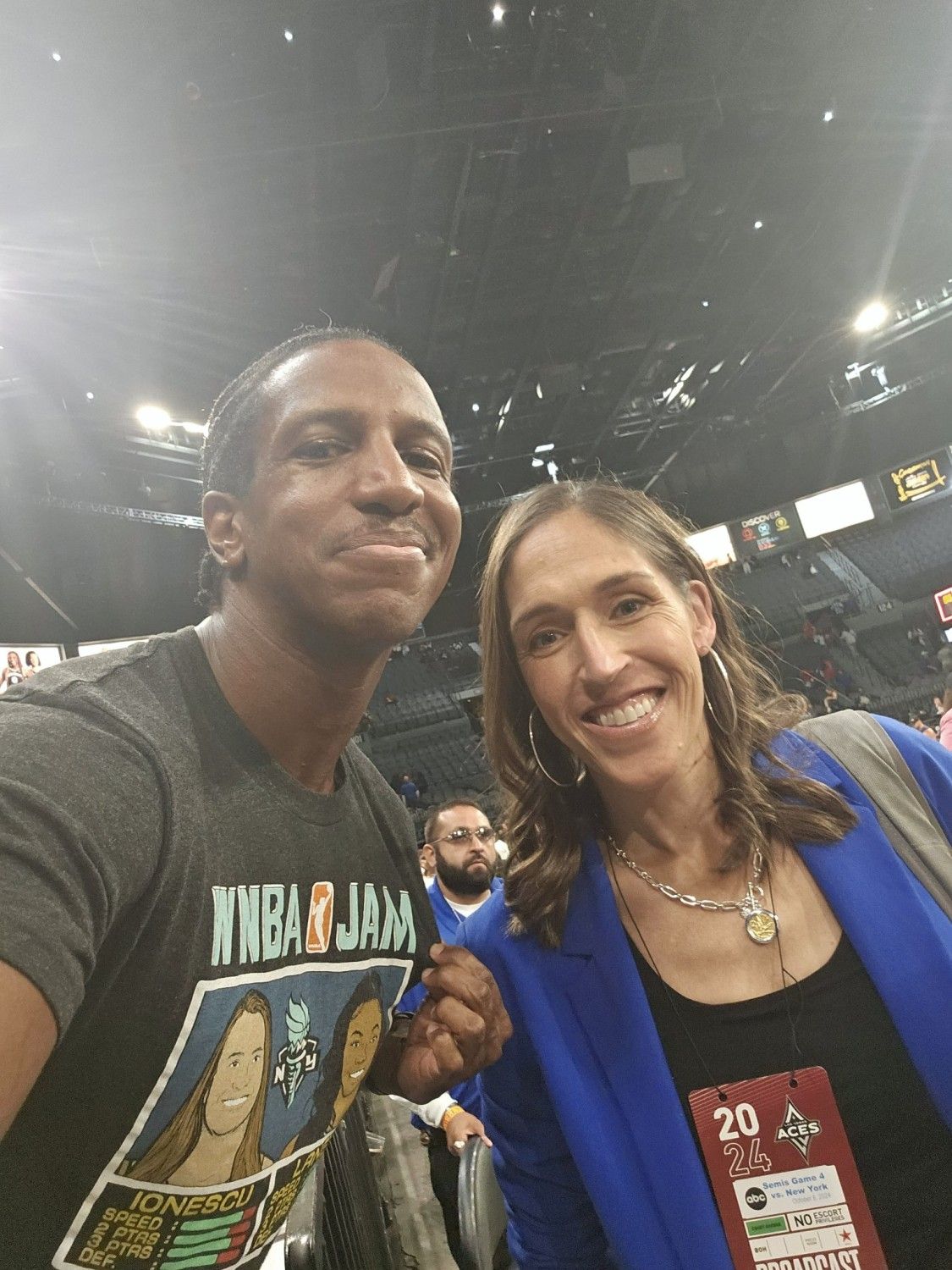
With WNBA legend and broadcaster Rebecca Lobo after a Liberty victory on the way to the 2024 WNBA championship.
Now, some of this insane valuation for the WNBA is due to the fact that there are just fewer WNBA teams. There are 32 NFL teams, 30 NBA teams, and only 13 WNBA teams. But it’s also about the fact that the WNBA is seen as an asset that is currently undervalued and has potential to deliver exponential returns. In investor speak, the WNBA is a tech company. The low market values and high potential returns make investing in the WNBA much more attractive (and affordable) right now.
Just so you don’t think I’m basing this on one franchise, here are a couple of other examples: Before the season, the New York Liberty sold a small percentage of the franchise at a valuation of $450 million. Liberty owners Joe Tsai and Clara Wu Tsai reportedly paid between $10 million and $14 million for the team in 2019. That’s a hypothetical 32x-45x return on investment in six years.
In 2021, Las Vegas Raiders owner Mark Davis bought the Las Vegas Aces for $2 million. Before the 2025 season, Forbes estimated the Aces were valued at $310 million—that was before they won the WNBA championship, before they opened a new arena, and before their superstar center became the first basketball player ever to win Defensive Player of the Year, the scoring championship, league MVP and Finals MVP in the same year. (Notice I said basketball player, not WNBA player. A’ja Wilson is the world’s greatest living basketball player, and I will argue that point with anyone.) So, in just four years, even before this record-breaking season started and his team won another championship, Mark Davis had increased his investment by 150 times.
Even in the stupifyingly stupid world of professional sports team valuations, these numbers are stupid.
Celebrating the New York Liberty's playoff victory in Las Vegas' Michelob Arena in 2024.
And that brings us to the WNBA strike/lockout
The WNBA players know all of this. Not only have they seen it all happening, but the players’ union is led by two women who operated a rival league (aptly named Unrivaled) and who understand how to read a 10-K investment report.
The WNBA’s union is demanding that players receive compensation as a percentage of revenue rather than a set number. WNBA owners are fighting that for obvious reasons.
If they can keep the player cap at a set number that increases or decreases every year, they can keep more revenue and profit for themselves. That number will be static no matter how much money the owners or the league make.
That’s why this story matters: WNBA players are fighting for essentially what all organized labor in the US should be fighting for right now—revenue sharing. Because as large corporations take greater and greater slices of incoming revenue, the only way regular people can get a reasonable share of it is through organized labor and collective bargaining.
How this is all being driven by the U.S. stock market
The massive increase in revenue has all been made possible by the Fed and the US stock market, which has been defying the laws of physics and economics for about a decade.
Tech companies like Amazon and Alphabet have insane amounts of cash literally just sitting around. It’s money they can’t find a use for, even after buying back stock, giving executives massive raises and bonuses and acquiring smaller competitors.
Amazon has $98 billion in cash and Alphabet around $111 billion. They put it in US government bonds so they don’t have to store it physically in silos or something, but really it’s just idle money.
So, they have been and likely will continue spending it on acquiring sports rights to bolster their streaming services, which don’t actually make money, but again money doesn’t matter. Even with the so-called AI boom, companies cannot spend enough to dent the trillions of dollars just sitting in figurative cash piles on their balance sheets. In early 2024, US companies had $7 trillion in cash on their balance sheets.
Unfortunately for the WNBA owners, the players have seen how this experiment works in real time and in a league not too dissimilar from their own.
NBA salaries have risen dramatically since the last collective bargaining agreement and that’s largely because the league’s overall revenue has risen dramatically. The NBA salary cap is determined by the league’s revenue, with players getting 51%. So, when the NBA signed its latest $76 billion licensing deals with Disney, NBCUniversal, Alphabet, and Amazon, half of that money went to the NBA Players Association in the form of an increased salary cap, higher pensions, improved health care, etc.
But remember that when you see someone like Shai Gilgeous-Alexander signing a four-year, $285 million supermax contract extension, it’s because the owner of his team signed something like a four-year, $2.5 billion contract extension ($76 billion divided by 30 teams).
For obvious reasons, WNBA players want a similar deal and understand that accepting a deal including a static salary cap that increases by a few percentage points each year would be an unforgiveable blunder for them, both now and in the future.
The players have been watching what’s happening in the NBA and other leagues. Over the past five years, streaming has made it possible for tech companies to enter bidding wars for sports at ludicrous levels. So the players union knows better than to settle for anything less than a revenue split because revenue is very likely to increase astronomically in the future.
That’s why the news last week that the WNBA offered players a new salary cap with a maximum salary of $1.1 million and a minimum of $220,000 was laughable. First, it completely undermined the WNBA’s position that it can’t afford to pay players more. Second, players have been watching the NBA’s 51% revenue split and have seen the results.
Here’s the last 10 years of the NBA salary cap:
- 2015–16: $70 million
- 2016–17: $94.1 million
- 2017–18: $99.1 million
- 2018–19: $101.9 million
- 2019–20: $109.14 million
- 2020–21: $109.14 million (COVID)
- 2021–22: $112.41 million
- 2022–23: $123.66 million
- 2023–24: $136.02 million
- 2024–25: $140.59 million
- 2025–26: $154.65 million
In just 10 years, the cap more than doubled and the increase from just the 21-22 season to the 25-26 season was over $42 million. The NBA still has 15-player rosters and 30 teams. That means all that increase went directly to players and the players association.
So, why would WNBA players settle for a static cap increasing just a few percentage points each year? And why would American workers settle for such a thing?
This is why the AFL-CIO, the largest federation of labor unions in America, has joined with the WNBPA to help get players a better deal. They recognize the public relations opportunity here.
Union membership has been declining since the 1980s, when corporations first started getting help from the Reagan administration and the federal government. The union rate was over 20% then and has been cut roughly in half since. Large companies have also had help from the Fed in stamping out union organizing.
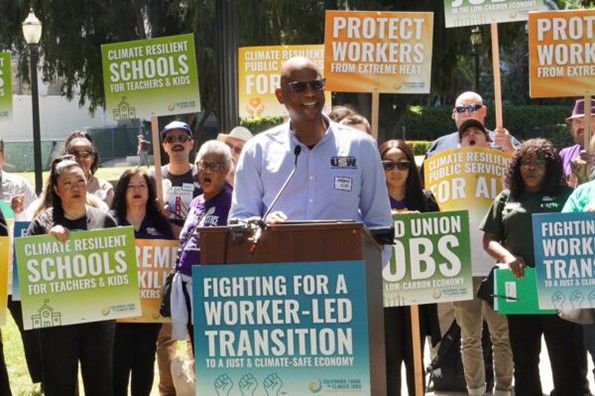
From a labor rally in California earlier this year.
However, in recent years, the decline has stopped, and labor unions have been winning major battles against corporations.
For example:
- In 2023, United Auto Workers secured an average wage increase of about 25% over 4.5 years, with entry-level pay rising nearly 40%.
- In 2023, the Teamsters union got UPS to agree to average 17% wage increases over 5 years with safety improvements.
- In 2021, the Transport Workers Union won raises of 12% to 17.5% over 3-5 years with enhancements in health and safety.
These were huge wins but pale compared to what the WNBA is trying to do. The WNBA wants to turn a defined-salary workforce into a revenue-sharing workforce. That’s a sea change not seen at this level in a generation.
WNBA owners, the league, the NBA and various corporate interests are fighting this because they understand how substantially it could cut into their share of revenue. Further, if AFL-CIO secures this win, it sets a new gold standard for all unions negotiating with ownership.
In 2024, about 13% of US GDP went to corporations—near a record high—and 2025 is on pace to break that record. Corporations are amassing more power and taking a bigger share of money spent in the country than ever before. Ownership’s goal has been to keep as much of that for themselves, and over the last 40 years, they have succeeded.
Things could be changing. That’s what AFL-CIO and other unions hope as they watch and engage in WNBA bargaining.
The role of skilled labor in our new economy
And this brings us to artificial intelligence. As I said in my last newsletter, the supposed AI spending boom that is powering the stock market is mostly a facade. Companies are spending money investing in technology, but AI technology isn’t actually doing much to increase companies’ value.
A recent study from MIT found that despite $30–40 billion of investment into generative AI, “95% of organizations are getting zero return.”
The part of the report that really caught my attention, though, was this:
“While only 40% of companies say they purchased an official LLM subscription, workers from over 90% of the companies we surveyed reported regular use of personal AI tools for work tasks. In fact, almost every single person used an LLM in some form for their work.”
And this is where the rubber meets the road. Workers – not technology or capital spending or strategic vision or narrative storytelling – are going to be the key to the future. What is distinguishing companies that are succeeding with AI from those that are failing is how their workforces are using AI. You can buy all the great tech you want, but if your workers aren’t using it in a way that helps you operate more efficiently, it doesn’t matter.
This takes us back to the WNBA, where the workers are obviously irreplaceable. As AI starts to infiltrate more of our world and automate more jobs, the need for skilled workers will increase, not decrease. The WNBA players in their quest for revenue sharing are setting a blueprint for future unions of skilled workers to follow.
Yes, workers will need to prove that they are as irreplaceable as professional athletes, but as AI is used to replace more and more jobs, the labor that remains will essentially be just that.
If the owners can throw enough money at the players to get them to back off of their desire for revenue sharing, all of corporate America will have dodged a bullet. But if the players succeed, organized labor will have a blueprint for taking a previously undervalued workforce and guiding it from a static pay structure into a revenue share, and if the WNBA’s revenues continue to rise as expected that will be a lot of revenue.
This has the potential to change the framework around how labor deals are negotiated going forward and to rewrite the rulebook on just how much skilled laborers can demand.
It’s possible that I’m overarching here or that this could be limited to the WNBA, but I doubt it.
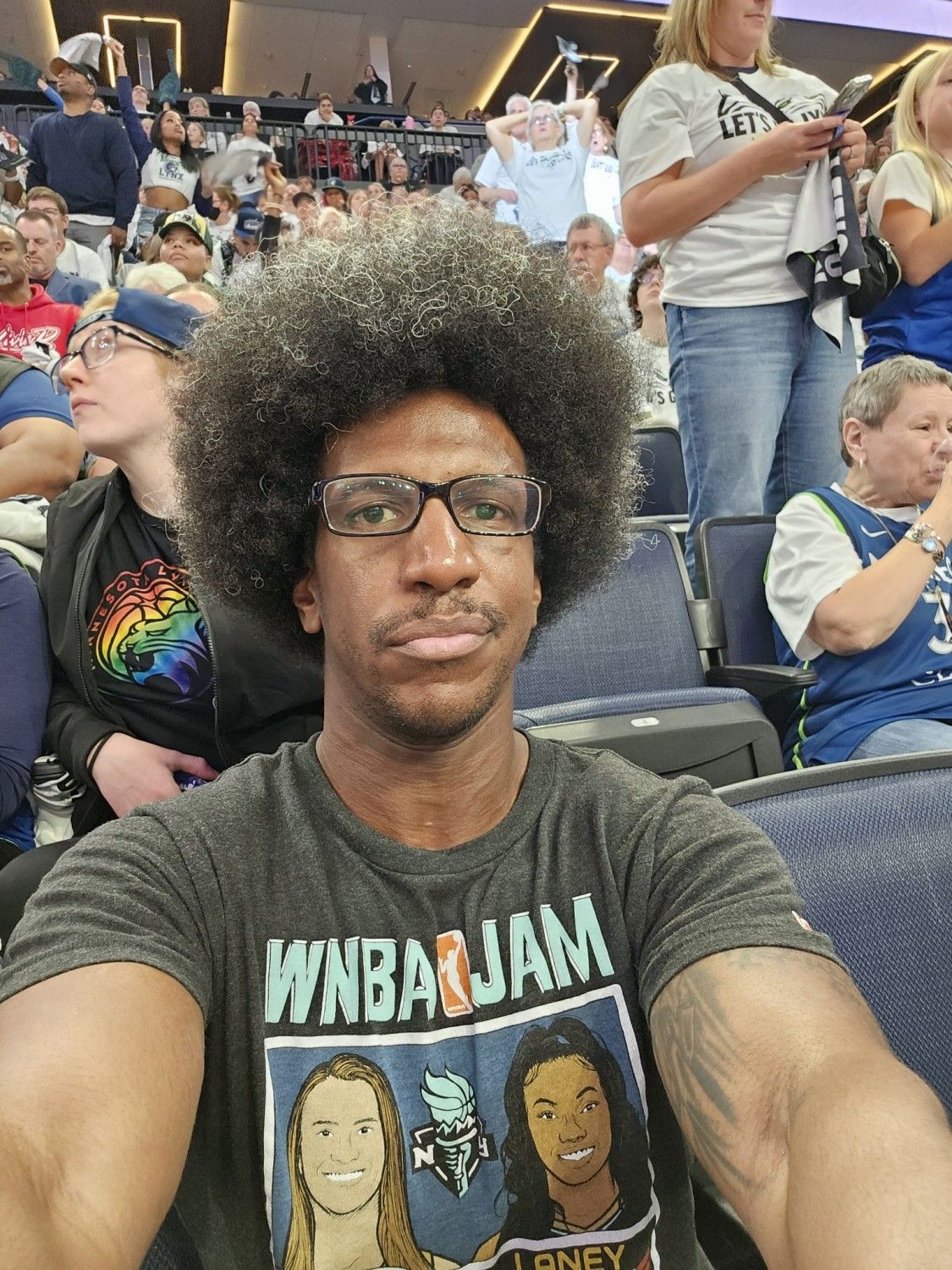
In Minneapolis for the 2024 WNBA Finals. Yes, I wore the same shirt to every game. And we won!