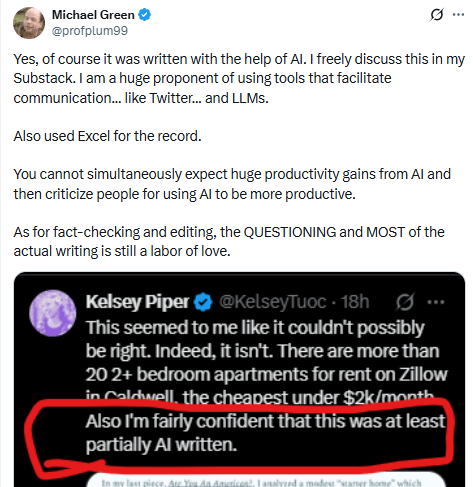

Mike Green published a piece redefining the poverty line at $140k. Some people debated his math. But a lot of people just said, "He used AI" and moved on.
Which - it's an observation worth making here.
The math debate was substantive. People like Noah Smith and Scott Winship picked apart his methodology - averages vs. medians, unsourced numbers, category confusion. Those critiques required actual knowledge to deploy.
But the substantive replies didn't spread as fast.
Contrast that against "He used AI" which spread kind of instantly. Conveniently, you don't need to understand poverty calculations to say those three words. You just have to say it and repeat it. The rest takes care of itself.
Quick recap: One strategy requires expertise. The other requires nothing. Guess which one won the online conversation? More importantly, guess why it matters to notice?
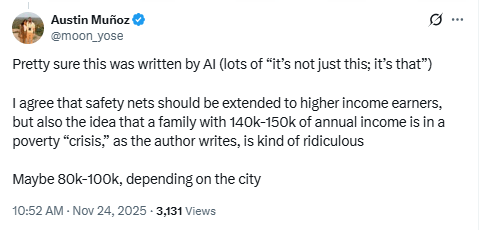
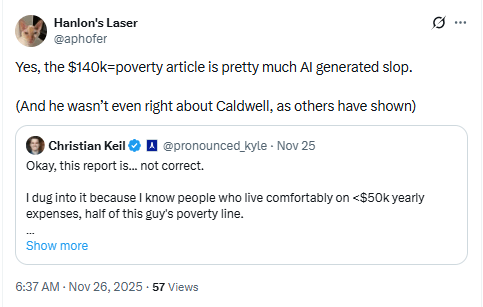
This tool-criticism tactic is well proven here. When something threatens you - whether you're a financial institution, a tech company, a government agency, or anyone defending the status quo - you don't have to win the debate. You just have to tell a faster story.
Green's piece said the real poverty line is $140k, not (the more publicly quoted/cited/used) $31k. That's a multiple orders of magnitude leap, and it represents a direct threat to how we talk about who's struggling and who's not. It threatens the entire apparatus built around the official number. A lot of people went online and said, "Wow. I felt this but hadn't put a number on it. I see it too."
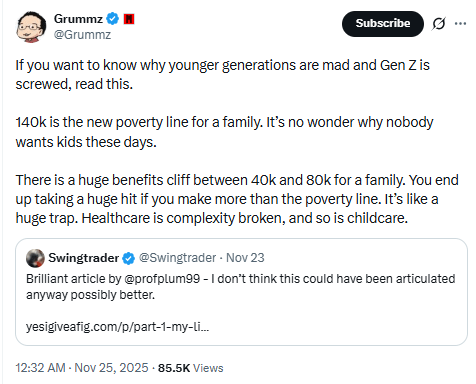
They (mostly) didn't do any math, but the vibes checked out. That's one type of response. Then there were the people who actually engaged with his math. Some of those took the time to say "actually, here's why that calculation doesn't work." And that takes work. It takes knowledge. It takes being open to picking a fight with Mike too.
Or, you could say "looks AI-generated, so how do we know it's even authentic?" That takes nothing. Anyone can say it. It spreads fastest. And it interrupts the original story before it gets too far.
Tool-criticism is more effective than substantive criticism because it doesn't require you to know anything. You're not debating the claim. You're attacking how the claim was made.
Using AI-criticism as a dismissal tactic is still relatively new. We'll only see more of it. We'll especially see it online, where speed wins over accuracy.
The lesson is simple, the observation is simpler (once you start seeing it): when someone makes a point that troubles you, you don't counter the point. Go find a faster-spreading story about the point-maker.
Is their methodology sound? Did they use the right tools? Who funds them? What are they trying to sell? These are fair questions to ask. Sometimes.But, if you’re asking them in good faith - because you actually care about accuracy and the future of humanity - that won’t go viral. Asking them as a dismissal tactic will.
Those questions might be fair. They might be unfair. Doesn't matter. What matters is they spread faster than the original claim, and they require zero expertise to repeat. This is narrative diffusion in the real world. “He used AI” is a new discrediting hack.
The case against Mike Green works because it's not about his math. It's about creating an easier story to spread instead of engaging his story at all.
Don't believe me? Read the comments.