January 21, 2026·Money
Wager Nation: Prediction Markets
Mike Smith·article

Mike Smith is a Partner and Co-Chief Investment Officer at Global Endowment Management (GEM), a fund of funds based in Charlotte, NC. He’s had a long career as an institutional allocator, with prior stops at the University of Florida and Duke University. I've been the beneficiary of Mike's insights for about a decade now, and now you can be, too, through his substack -- Simple But Not Easy -- written under his nom de guerre Bearded Miguel. You should definitely check out Bearded Miguel's substack, and you can contact him on Twitter @beardedmiguel. And yes, Mike's beard is glorious!
As with all of our guest contributors, Mike’s post may not represent the views of Perscient, and should not be construed as advice to purchase or sell any security.
The first indication of an American incursion into Venezuela on The Bloomberg came at 1:12 am Saturday morning with the AFP reporting “Explosions heard in Caracas.”
By that point the Polymarket odds that Maduro would be removed from power by the end of January had doubled from a few hours earlier to 12%; the market was essentially 50% by 1:50 am. About 3-½ hours later President Trump officially confirmed Maduro had been captured and flown out of the country. At least one punter made nearly half a million dollars betting on Maduro’s ouster before the end of the month1.
NPR warned that the trader’s success “raises insider trading questions on Polymarket.” Actually, it does not. Trading with inside information isn’t just permitted in prediction markets, it’s encouraged. NPR doesn’t quite understand their topic2 which is clear when they note the SEC polices insider trading but “far fewer guardrails are in place to keep prediction markets in line.” This betrays a common misunderstanding about what insider trading laws are and how they work3. NPR blames prediction market oversight falling to the Commodity Futures Trading Commission “with one-eighth of the staff of the SEC,” but there’s no such thing as “insider trading” in commodity markets.
Much of the Securities Exchange Act of 1934, which created the SEC, demonstrated a frustration with how rigged equity markets had been against the retail speculator. That was reflected in things like the prohibition against market manipulation (a primary tool of pool operators in the 1920s) and various disclosure requirements for large shareholders. But the misuse of material non-public information isn’t illegal because it’s “unfair” to the people who don’t have it, but rather because it violates a fiduciary duty owed to the company itself. In 2019 Congress attempted to amend Section 10(b) to eliminate the “gap” that exists from requiring a breach of fiduciary duty to pursue insider trading charges, but the proposed Insider Trading Prohibition Act failed to pass4.
Over my holiday break I noticed a surge in stories about wildly successful Polymarket traders. Of course, you have to be careful extrapolating trends from your own social media feed since the algo is programmed to feed you more of what you engage with5. Two things stood out: the first was the stories mostly involved the crypto-native exchange Polymarket (rather than Kalshi which has been running the Bet on Everything ad during college bowl games), and they mostly involved stories of traders creating Bots to automatically carry out winning trades (often via arbitrage).

That’s notable because it distinguishes these stories from casinos that trumpet the occasional big winner to attract the army of losers who fund them both. Most of the stories were not the narrative type of “smart guy figured out something before it happened6” they were “smart guy built a Bot to make free money.” One highlighted Bot was the classic tail buyer, acquiring small stakes across multiple markets and profiting from the rare wins at huge multiples. Another highlighted Bot supposedly turned a grand into $2 million via “microstructure arbitrage.” Based on the post I’m not exactly sure what that means other than a LOT of trading. The classic case, which shouldn’t exist, is accumulating small positions in “Yes” and “No” around short-term events that add up to less than $1.00. That’s enabled by markets that allow betting on 15-minute moves in crypto (where Poly is attempting to add some friction).
Exactly what is accomplished by this hype isn’t entirely clear, although obviously any market maker benefits from more activity on their platform. I suppose that’s true whether someone is taking the Tetlock approach or building Bots. I noticed many people credited vibe coding for their trading Bots, so something clicked when I saw a PSA from a purported prediction market trader. Dominatos warned against the blind use of various prediction market tools being touted on the socials, some of which were “straight-up wallet drainers.” Probably the most vital warning was to use a separate wallet rather than having their main funds piped to Poly. A market of Bots is very good if you make better Bots, and especially if you “help” other people make faulty Bots.
When I say that prediction markets encourage trading on inside information that’s not hyperbole. Last month Coinbase CEO Lex Luthor Brian Armstrong appeared at the Dealbook Summit where he addressed his October earnings call stunt when he read off a list of words prediction markets accepted wagers on him saying. The so-called “mention markets” had $84,000 of bets on words like Bitcoin, Ethereum, blockchain, staking, web3, and Armstrong dutifully recited them all at once making winners out of everyone betting yes. Armstrong said he was “just having a little bit of fun,” and noted he obviously didn’t trade on the market himself. But he could have7.
ARS weirdly asked Armstrong if he was worried about manipulation, after recounting a story of how he had manipulated the mention markets, but his answer was telling. Armstrong responded that he fielded a question from a CFTC nominee on whether insider trading should be allowed in prediction markets. While he called it “nuanced” he said for the “99% of people” using the markets to assess probabilities, you want traders with insider information “so you get a higher quality signal.” Of course, that argument works for any market; in fact in 1966 Henry Manne argued that insider trading should be legalized because it would result in more efficient stock prices.
This swerves into another big question with respect to prediction markets: what is the social utility of accurately forecasting which character on Stranger Things will be killed off at the end of season five? Or how long Trump and Zelenskyy will shake hands when they next meet?8 My guess is capital markets are much too large today to get any benefit from insiders disseminating information, but at least if it worked there would be some purpose to it. A Google employee making 10x gains on search trends is of dubious value to markets. An obvious related question is how sustainable a market is when it’s very badly weighted towards inside information? Maybe that’s why Kalshi raised a billion dollars, to continue funding its marketing machine.
One market with obvious utility was one of the first prediction markets: elections. The Iowa Electronic Market was launched in 1988 specifically focused on election outcomes. It’s a quaint operation compared to today’s followers not only for its narrow focus but its tiny scope: all markets are limited to $500 per trader. Launched for the sake of academic research, IEM always had a collaborative relationship with regulators, and was allowed to operate with real money as early as the 1992 presidential election (when the market handily outperformed polls on less than $80k in total investments). Several imitators have disappeared over the years, notably Intrade which lost access to US traders in 2012, leading to financial trouble. The industry’s regulatory treatment has come a long way since then; Polymarket, which appeared built specifically to skirt US law, gained US approval last July, Donald Trump Jr. is a board member both there and its chief rival Kalshi, and the president’s social media platform intends to launch a prediction market (where presumably his son will serve on the board).
Obviously society is full of legal things with questionable social value and personally I wouldn’t dream of attempting to ban prediction markets, or even to regulate them in a way that exceeds the CFTC’s current oversight. But, I do want more people to realize they’re bad for us, at least in this current cancerous form. I referenced Professor Philip Tetlock earlier who wrote the book on Superforecasting, and runs a website that tests his theories in real time. Of course the only skin in the game is one’s Brier Score, which isn’t the same as money. However, one interesting result from the historical success of the IEM in forecasting elections was how small the monetary incentive could be and still produce superior results.
Tetlock’s insights are not around punting but probabilistic reasoning. The best forecasters share certain traits that allows a housewife in Peoria to better handicap the odds North Korea will launch a ballistic missile than (say) Ian Bremmer (Tetlock’s earlier book exposed expert political judgement as bunk). In 2011 Tetlock entered his Good Judgment Project team into a forecasting contest run by the Intelligence Advanced Research Projects Activity (IARPA). The wisdom of the crowd was augmented with training on overcoming cognitive biases and best practices in forecasting. The contest consisted of over a hundred geopolitical questions and initially included five teams. After several rounds GJP was the only team still receiving IARPA-ACE funding.
Tetlock’s superforecasters share certain traits, chief among them is Bayesian thinking, continual updating of forecasts, and beginning with a base rate (outside view). Tetlock is quick to warn that humans can’t achieve true Bayesian estimation, but the best forecasters are better at it than most. At heart, this just means thinking in terms of probabilities rather than binary outcomes, and a willingness to adjust your expectations as new facts emerge. The best amateurs also are able to overcome cognitive biases, which is probably the primary reason experts are so bad at forecasting9. If your expertise is China’s political development after the Cultural Revolution, most of your predictions about China will be grounded in that experience (in the industry lingo, the expert is the hedgehog and the amateurs are foxes). Open-mindedness is a key feature of superforecasters, as is humility. Tetlock preaches an “error balancing process” that tries to avoid both over-conservatism and jumpy changes. GJO also posed the Maduro question, in their case removal by September 19th, and the crowd was above 50% 18 days before the close10.
Most “overnight successes” are decades in the making, and that’s true for prediction markets. Robert Shiller proposed substantive prediction markets for hedging over 20 years ago, which later became part of a book, and even spawned a failed attempt at a futures market for home prices (which Polymarket is resurrecting because of course). The Journal of Prediction markets was launched in 2012 (although topics often vary markedly from the current meaning). Around that time there was a lot of focus on internal prediction markets at corporations which used them to make estimates of important operating metrics. Betting on the next Pope has been with us for at least a dozen years now, but 60 Minutes interviews of a punter who called a 250-to-1 shot on the first American Pope is a very recent phenomenon.
One early attempt at a prediction market for substantive events was the Defense Advanced Research Projects Agency’s (DARPA) effort to create a market for geopolitical events that could augment intelligence analysis. In the shadow of 9/11 and with rumors terrorists may have bought put options on the targeted airlines11, critics labeled the effort “terrorism futures,” and the idea was quickly dropped. In a humorous retelling, Justin Wolfers and Eric Zitzewitz recounted how following the controversy Tradesports created a market to bet on Admiral John Poindexter’s removal as head of DARPA by August 2003 (“yes” paid).
A little too on the nose
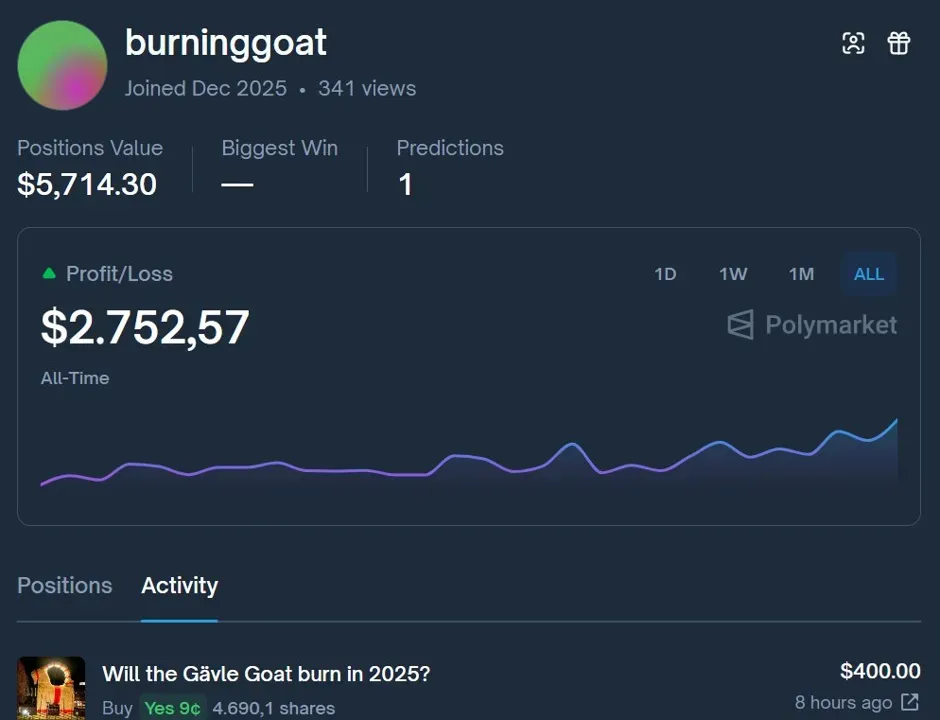
One obvious concern with prediction market questions on terrorism is the risk someone could bet on an event and literally make it happen; that’s something people seem to take for granted with today’s markets. Last month someone observed a Poly user making a big bet that vandals would torch Sweden’s giant straw goat; the user’s name was “burninggoat” (the goat was blown over before anyone had a chance to burn it). An even more banal example also occurred last month when the Kabuto King began publicizing his accumulation of a very common Pokémon card, and Polymarket created a question for whether the first edition would hit $100 by year-end. It was immediately apparent that an illiquid collectable market would be easy to manipulate. That almost certainly happened, and “yes” bettors were paid. This week WH Press Secretary Karoline Leavitt abruptly ended a press conference just short of Poly’s betting line, collapsing a 98% probability to zero in seconds. X was atwitter with conspiracy theories, understandably (did I mention one of Trump’s sons is on the board of Polymarket?).

There are two views on these shenanigans
Just as prediction markets have recreated insider trading from first principles, they seem to be doing the same with cash investing. There’s apparently a wallet with nearly $3 million deployed for the sake of earning a 4% interest rate (but, crypto™!). Another way to do this is bet “no” on markets where if you’re wrong the trades will never clear, but getting a price that equates to bank interest.
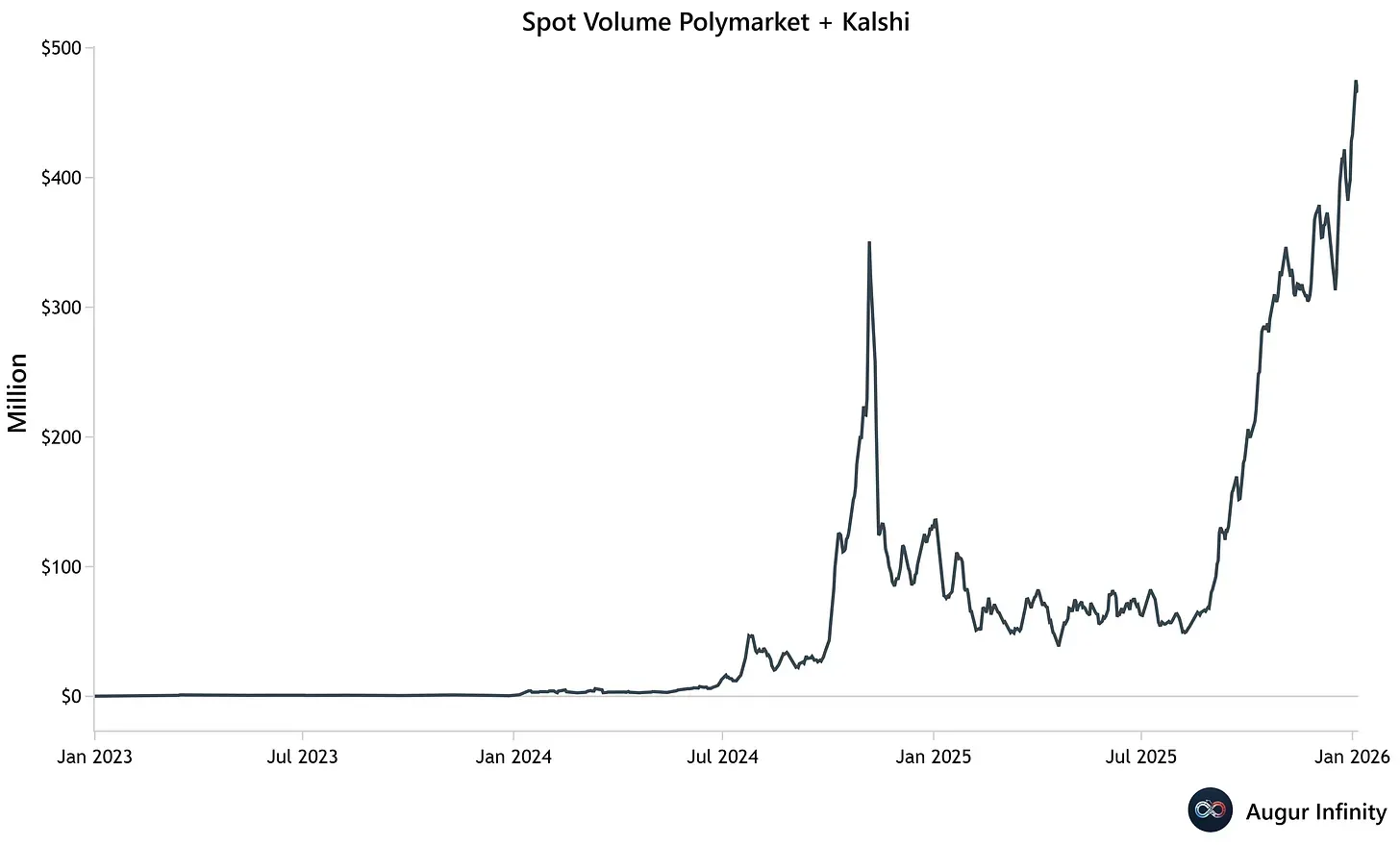
The momentum of these markets in terms of both volume and zeitgeist is bewildering, like they’re speeding towards some singularity. Broad legalization of sports betting has attracted both prediction markets and brokers under the auspices of derivatives law. The same impulse that drives betting on the length of White House press conferences has made 0DTE options half of CBOE volume (that is to say, financial nihilism). Robinhood recently created sucker parlays from first principles; this is an incredibly stupid thing to do. Again, markets benefit from flow, but even dumb stock trades can look good relative to sports betting since over time stocks go up. In a way, the stock market protects degens from themselves with a rising tide12. Tenev seems to have forgotten that you can sheer a sheep many times, but skin ‘em only once.
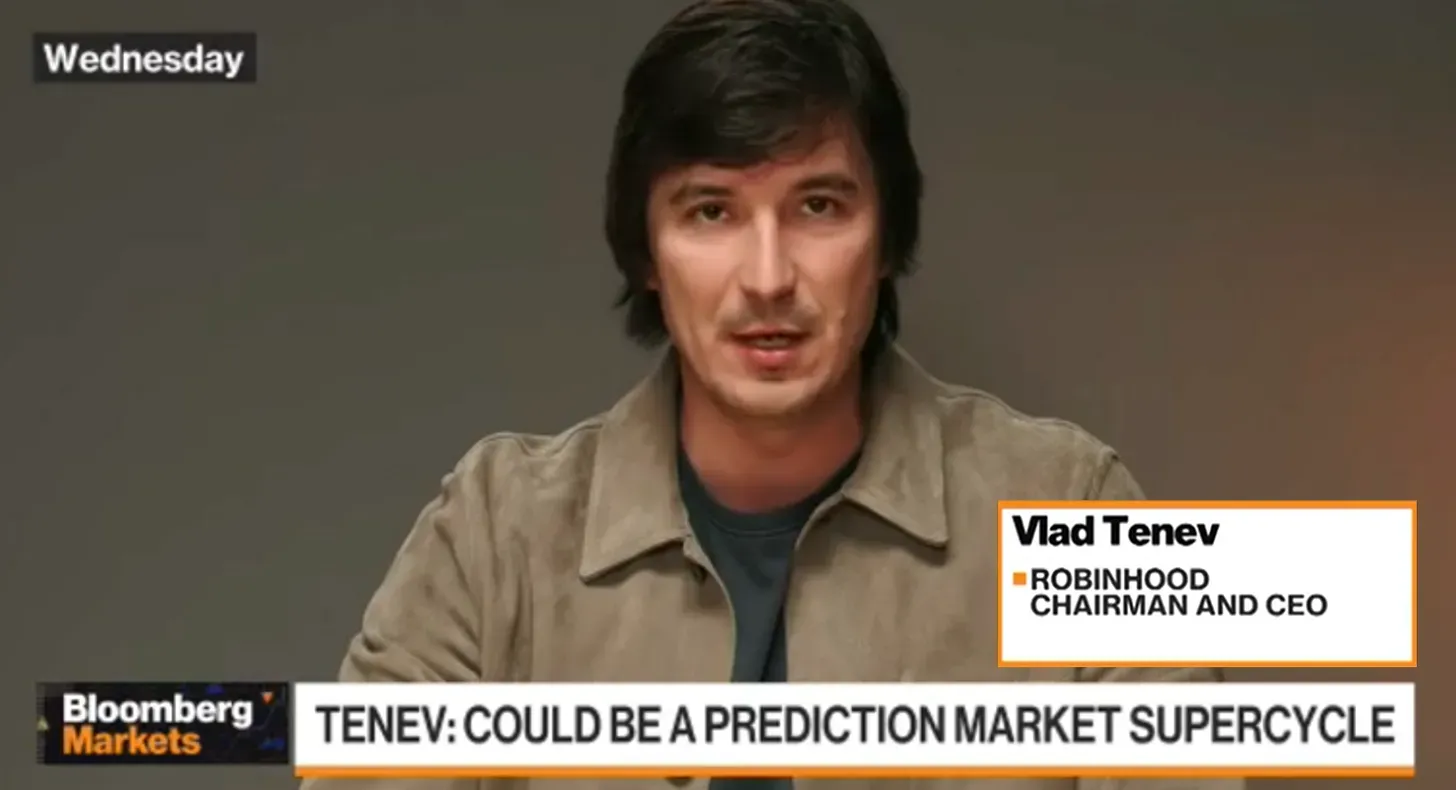
This week Dow Jones announced a partnership with Polymarket to integrate the company’s probabilities into its content, further increasing the amount of automated content in the paper. Traditional journalism is just moving closer to The Polymarket Times - an agenic content producer driven by what punters are betting on. Weeee! The central tension here is a simple temporal mismatch: the most useful prediction markets address medium to long-term question, while the markets most profitable for the providers settle every 15 minutes.

On Thursday Bloomberg reported that President Trump was considering “bipartisan” CFTC picks; like other major Federal agencies the CFTC is bipartisan by design, it’s just that these selections would be the first Dems added to a major Street regulator in the second term. The Democrat names floated included a lobbyist for a market maker and a trader who oversees prediction markets at his firm. Red or blue, as long as it’s green. Prediction markets have been around a long time but they’re really having their moment as financial nihilism meets the golden age of grift.
1. A smaller player credited his win on monitoring the activity of Domino’s Pizza near the Pentagon. There’s an entire account for this launched last year that also monitors how busy local gay bars are. Notably those who bet on an “invasion” were not paid. ↩
2. In their defense they likely were still grieving after seeing a fellow socialist dragged from power. ↩
3. None of this is legal advice. If in doubt, don’t trade. For things like the CFA, and I’m guessing law school, the answer to any question is not the most moral thing you can imagine, it’s the letter of the ethics code/law. ↩
4. It’s worth observing that the Speaker of the House at the time was Nancy Pelosi, probably one of the greatest traders this country has ever produced. ↩
5. Note, this is why Congressman Gooner’s (D, CA) explanation for scrolling porn on a commercial flight was less of a defense than he imagined it to be. ↩
6. There is a humorous exception here involving people who bet on other people playing video games and a return on capital of over 1,000x. It’s funny because it seems obvious someone launched a market with an over/under of 2.5 maps (think of it as game time) when the match in question was tied one-to-one, making the over seem like an obvious bet. “But Kopite refused to play map 3, and Komodo was awarded the win.” It’s possible the punter was a pal of Kopite, but in any case the overs failed to consider the tail of a forfeit and were steamrolled attempting to pocket a nickel. Now that’s funny. ↩
7. Which obviously would be silly for someone worth over $11 billion. ↩
8. The traders who did deep research on past meetings to bet on two to six seconds won. ↩
9. There’s also Upton Sinclair’s warning that “It is difficult to get a man to understand something when his salary depends on his not understanding it.” Political scientist Ted Hopf wrote in 1993 that experts in his field failed to predict the demise of the Soviet Union because the US military establishment set the government financing priorities. In other words, there was simply no incentive to imagine the world without the Red Threat. ↩
10. GJO’s Khamenei market is for June 6th and is around 49% yes at the moment, compared to 35% odds on Polymarket. ↩
11. An extensive quantitative analysis later found no evidence of “unusual option market trading in the days leading up to September 11.” ↩
12. Of course, results may vary. ↩