War on the weekend, for anybody in and around markets, steals your attention. The war is always shocking, if not at least a little surprising, and it - without fail - triggers a deep dive into research and curious conversations and anxious after-hours price checks so that by Monday morning you've gotten yourself worked into whatever state you need to be before the opening bell.
The expectation shifts around "war" or "crisis" events always rhymes. You expect "risk" to at most get turned off, and at least turned down by a smidge. "Flight to safety" and "flight to quality" get pre-loaded into every news outlet's headline generators. "Safe assets" are the topic du jour in uncertain, trying, and volatile times alike.
And then, when the official investment committee calls started that Monday morning, I kept hearing the same sentence over and over from portfolio managers, allocators, and advisors:
“Ok, but also, did you see the yield on the 10-year? It’s up. Weird, right?”
That was the BIG observation that came up in every single conversation.
Safe assets are supposed to be the US Dollar and US Treasuries. There are some others you might throw into the mix, too (ex. Gold), but Dollars and Treasuries are the primary placeholders for big, deep, liquid markets that in uncertain times, you expect to see catch at least a little bit of a bid.
At the highest/most generalized level, the dollar went up. And, at the highest/most generalized level, the price of 10-year Treasuries went down.
This surprise is warranted. It’s earned in experience. But the more surprise somebody has for their reaction, the more I found myself reaching for some Perscient Pro charts. We don’t normally share these on Panoptica, but I can’t resist, and it helps so much to explain the context of what just happened.
Because while the explanations for the tick up in yields covers “probably oil” and “probably inflation” and even “the economy still is pretty healthy, and war could turn into stimulus, so…” which, we all know that’s just another version of “probably inflation” which misses the biggest theme. This isn’t new, so much as being newly experienced in a time of crisis.
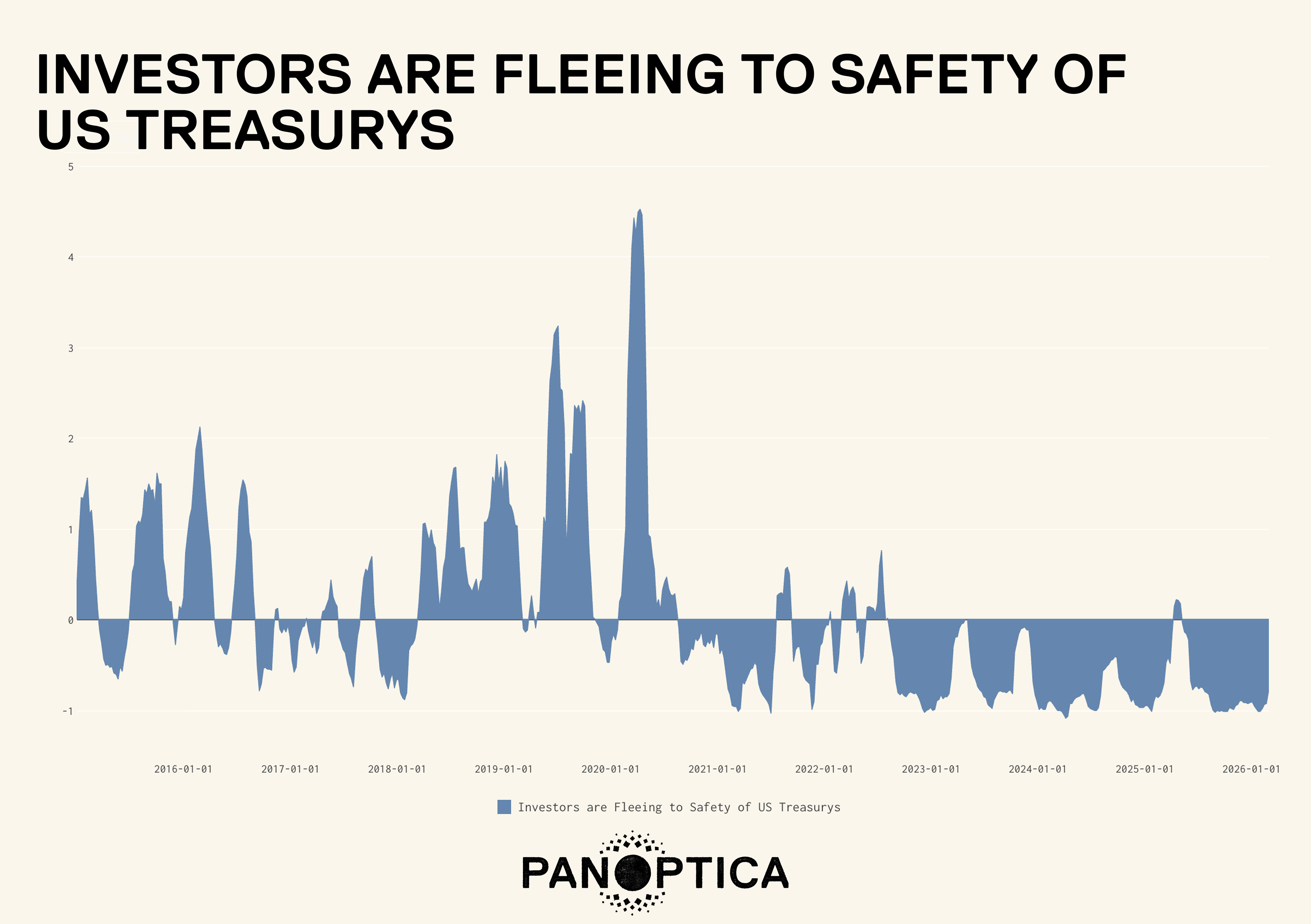
The idea that investors would flee to the safety of US Treasuries has been, you may be surprised to find out, out of favor for some time now. We have a Storyboard to illustrate the point. Note the negative view on this Signature, and just how long its framing has leaned negative:
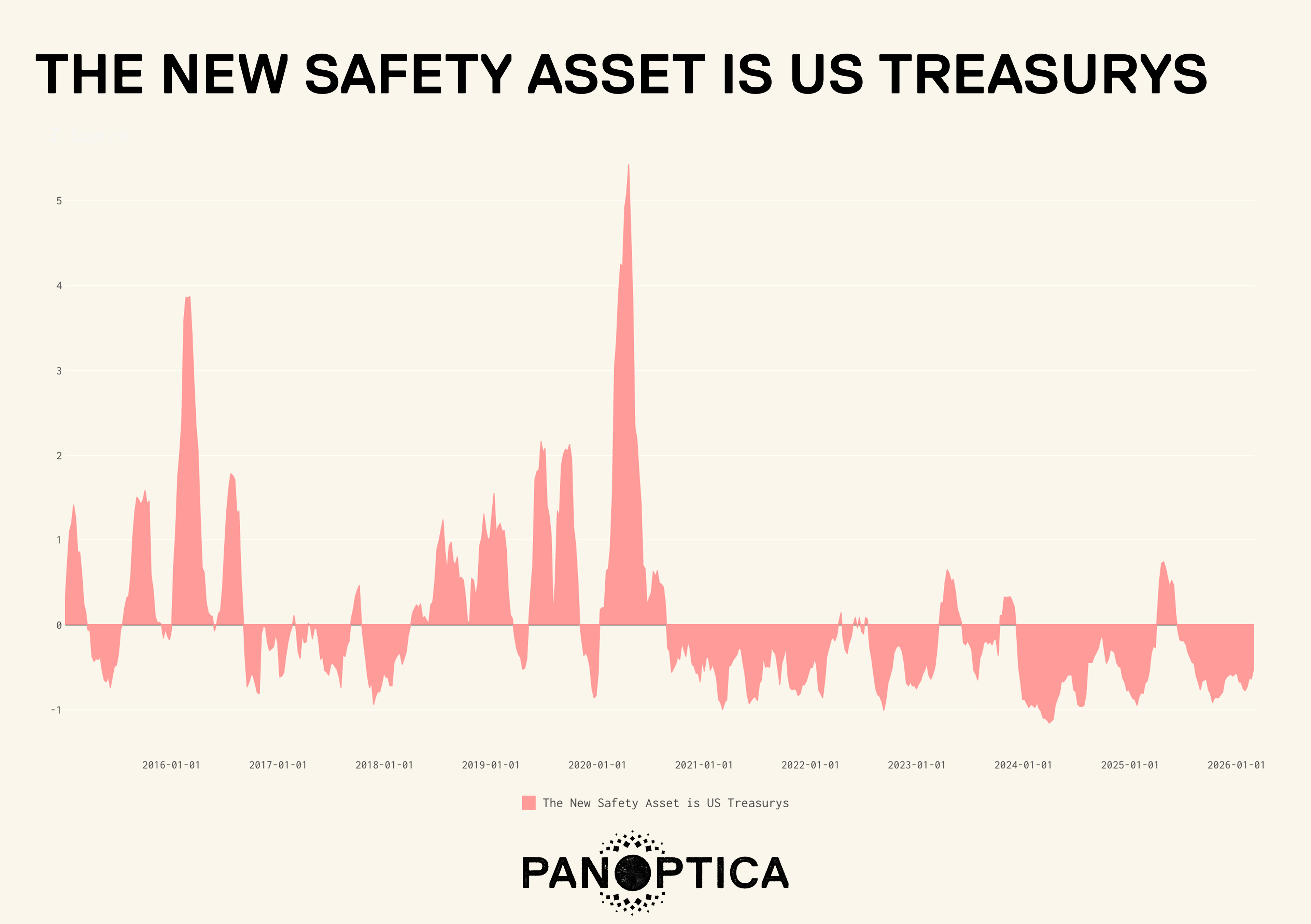
On top of that Signature, we also track the view of treasuries as “the NEW safety asset” and outside of a few blips, this hasn’t come back into style at all either:
Back in November of 2025, Ben Hunt wrote in “How I Learned To Stop Worrying And Love The Deficit”:
For decades now, US sovereign debt has enjoyed the privilege of being “the best house in a bad neighborhood”, so that if you wanted “duration” for whatever reason in your portfolio, you preferred long-dated US Treasuries to any other nation's sovereign debt. THAT is the narrative that has been shattered.
Ben said “now” in 2025, but it stretches back farther. Grant Williams has been connecting this idea to the removal of Russia from the SWIFT banking system in 2022. As Grant pointed out in “There Can Be Only Two,” you can see how the recycling mechanism for surplus capital started to quietly reroute around the dollar system instead of through it once non-US entities realized what happened to Russia could happen to them too. That was the introduction of a new risk premium, one we just haven't seen tested much since.
In both Ben and Grant's cases, the pandemic-era flight to quality never really reversed, it just shifted. The Storyboards above confirm what those Monday morning questions were getting at: the “safety asset” hierarchy has fundamentally reordered. It was there in 2020, it hiccupped in 2022, and in 2026 we're at the beginning of a newfound awareness of just how reordered that hierarchy has become.
The US Dollar may still have moved up after the war started, but the price of US Treasuries went down. Flight-to-safety and flight-to-quality aren’t what they used to be. If this situation escalates, if this situation gets worse before it gets better - and those both mean safety and quality will warrant a premium in the days, weeks, and months ahead - then these are the narratives you need to be tracking.