January 14, 2026·Stories of America
The Collapse of Trust That Markets Have (and Haven't) Priced In
Matt Zeigler·article
As 2026 gets underway, are the markets repricing America faster than America is changing?
The old trading adage - story follows price, and not the other way around - is priceless. But only if you broaden “price” to include capital movement. Because from there, all stories follow. It's why we can't talk about markets without talking about marketing. It's also why when capital starts moving, we want to know what new narratives are moving too, because there's great power when the flow direction finds its story.
We are in the midst of a major price + story overhaul + (re)alignment risk coming into 2026. At its core, the American leadership story is under distress. There's probably no surprise there, given the non-stop, neverending political headlines of the moment, but when we start to unpack our Storyboards tracking signatures on energy policy, US Dollar reserve status, and a central banker portfolio preference for gold, you’ll start to see a framework for where price has the potential to stretch stories to new extremes.
If you haven't seen these on Panoptica, I'll take you through each.
Starting with energy leadership, below you'll see a blue line representing "America has ceded its leadership in energy to other nations" laid over an orange line of "America will lead the energy renaissance of the 21st century." One would think these would zig and zag as contradicting statements. And they mostly did until 2025, when both narratives spiked hard, in the same direction, at the same time.

This more recent re-divergence is worth watching, especially to see what prices are moving to make these stories stick, since at least one of these is going to come down, with "America leading" currently in the lead and heading lower.
What prices are moving within these stories? Run your market screens. Because what's most clear about where we're going next is that institutional trust continues to be under threat. We see it across our Stories of America Storyboards, like this one on "US dollar reserve status coming under threat."

Tracking dollar trust against America's energy leadership is warranted. Especially when we add this "Gold is a better alternative to UST" chart to the mix, too:
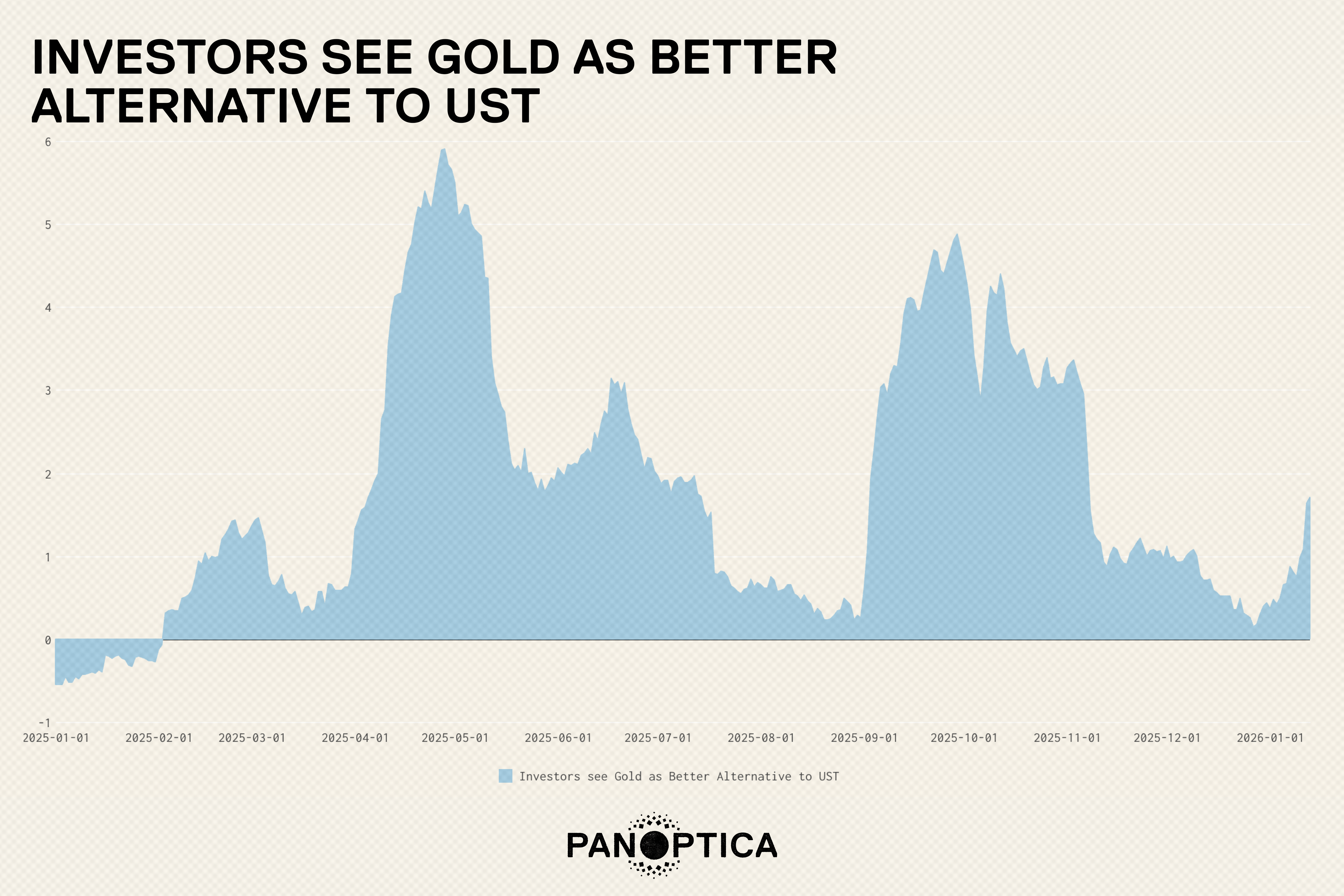
These are but 3 connected stories moving the most coming into 2026. They are ripe for price to stretch and pile in harder. Energy dominance is being questioned. Dollar trust is under stress, even if stress is currently declining. The preference to own gold is still rising. This isn't a calm set of indicators, to say the least. They are indicative of a new understanding of prior price trends taking root.
Grant Williams has been tracking this exact moment in his Things That Make You Go Hmmm letters and explicitly, with guests and friends, on his 100 Year Pivot podcast with Demitri Kofinas. I hosted him on a recent Excess Returns interview to summarize all of his findings, and he traced the mechanism that explains all three signals moving in concert in a way that definitely made me go "hmmm."
In early 2026, gold overtook US Treasury bonds as central banks' preferred reserve asset for the first time. Foreign central bank gold holdings reached $4 trillion. US Treasury holdings: $3.88 trillion. This crossover, between gold prices rising and outstanding treasury holdings dropping, has finally arrived.
Central banks from China, India, Turkey, Japan, France, Canada, UK, Belgium, and UAE all made the same decision in the past 5 years: move reserves into gold. Grant sees this as deliberate, intentional, and institutionally coordinated - not at all random market noise.
Tying it back to 2022, when America froze Russian assets, Grant said:
Every central bank in the world had a decision to make. What America did was basically say you can no longer trust in us as a partner for state-level, sovereign reserves. So central banks had to find a way of lessening their dependence on the dollar system.
Those decisions didn't just happen on a whim. They've been building since 2022, and here's the thing - the gold price really is the prime indicator here. When you look at where actual capital is flowing, not where rhetoric suggests it should flow, you see the truth of what the market already believes. The stories are still catching up to the last round of price moves, and probably gearing up for another (pull that gold price chart up now, if you haven’t already).
Grant's synopsis nails what these three signals are showing us. The energy "ceded" narrative has been accelerating (+5.90 points per month). The energy "will lead" narrative has been decelerating (-0.48 points per month). The gap between them is currently widening by +6.38 points monthly and now sits at +56.84 points wide. If prices start to hit harder again, in oil, dollar, rates, or growth stocks, these are very fertile story zones.
Political leaders in the US are still telling 2020 stories about American dominance and growth. Capital markets are operating in 2026, where central banks are divorcing from dollars at an increasing rate. The gold price and reserve numbers represent a price in search of an even stronger story.
That's not a prediction or a warning. It's how Panoptica Storyboards showcase divergence underway. Stronger price moves could tip these narratives into a much more extreme reality than we're currently in.*
If you're watching where capital actually moves, where price sets the stage for story, you see what the market already believes in these charts. America's institutional trust, once a given, is now being actively repriced.
Listen to Grant. Do your own homework. Just don't miss what's only starting to be priced and spread, via story.
The next biggest price to watch? Probably gold. But also the narratives that will continue to be matched by this data - energy leadership signals and capital allocation. The building blocks of the entire system are on the literal chopping block as 2026 starts, and we are likely to see some big moves.
*Even more data at Perscient.com