
This note was originally published on Adam's substack - The Choice Engine - on 12/01/2025.
Here is what the official statistics cannot see: the child who was never born.
American women say they want an average of 2.7 children.1 They are having 1.6.2 The gap of 1.1 children, the distance between the family desired and the family achieved, is not a lifestyle choice revealed by behavior. It is a forced substitution exposed by every survey that asks the question.
When researchers ask young adults why they are not having the children they want, they do not speak of liberation or preference. They speak of cost. In the 2025 American Family Survey, 43 percent of Americans cite “insufficient money” as the single most important reason for limiting the number of children they have. This is twice as prevalent as the next most common reason, “lack of personal desire” (22 percent).3
Open the Bureau of Labor Statistics spreadsheet and scroll to the bottom: you will find cigarettes, fireworks, and lottery tickets—every American appetite is catalogued. Only one commodity is erased from the ledger entirely: the daughter who was never conceived, the son who was never named. They are the only product our national accountants refuse to price, because pricing them would require admitting that the market failed to deliver the one good it was supposedly built to secure—the future itself.
And yet the CPI is used by the Federal Reserve, the Social Security Administration, and every policymaker who discusses “real wages” as though it measures whether Americans can afford the lives they are trying to build. It does not.
When policymakers treat this basket as a proxy for welfare or living standards, they commit a category error with profound consequences. The tyranny is not the metric, but the application. We are using a tool designed to track the price of milk to determine if a civilization can afford to reproduce itself. An index designed for consumers is being used to measure the welfare of reproducers. That is the error. The consequences of the error fall on the reproducers.
I. What This Argument Is and Is Not
Before proceeding, let me be precise about the claim. I am not claiming the Bureau of Labor Statistics (BLS) is incompetent or that quality improvements in goods like smartphones are illusory. The CPI is a defensible measure for its designed purpose: tracking price changes in a marginal basket of consumption goods.
My claim is that policymakers commit a category error by using this consumption index as a proxy for the welfare of reproducers. The goods tracked by the CPI are largely substitutable, marginal, and reversible. Family formation is none of these. It is a package of goods (housing, childcare, healthcare, career) that must be acquired together, in sequence, within a narrow biological window, and cannot be undone.
The standard economist’s response is that the CPI actually overstates inflation due to substitution bias.4 Grant this. It does not touch the argument. A thermometer can be exquisitely accurate while being useless for measuring blood pressure. The CPI is categorically unsuited for the purpose to which it is most often applied.
II. The Demographics of Foreclosure
Consider the young man who has become a statistic.
He is twenty-seven years old. He lives in his childhood bedroom. He has not been on a date in two years. Nearly 20 percent of men aged 25 to 34 now live with their parents.5 Sixty-three percent of men under thirty are single.6 The median age of first marriage has risen from 23 for men and 20 for women in 1956 to 30 and 29 today.7
These are not preferences revealed. They are outcomes imposed.
Recent modeling of the 2010 birth cohort confirms this imposition is rigid and sticky. Researchers Lee and Yoo found that by age 30, approximately 15 percent of this generation has effectively “given up” on homeownership, crossing a mathematical threshold where the probability of ownership falls below 50 percent. Once that line is crossed, it is less a hurdle than an economic event horizon. The data projects that 98 percent of those who have ‘given up’ by 30 will still be locked out of the market by age 40.8
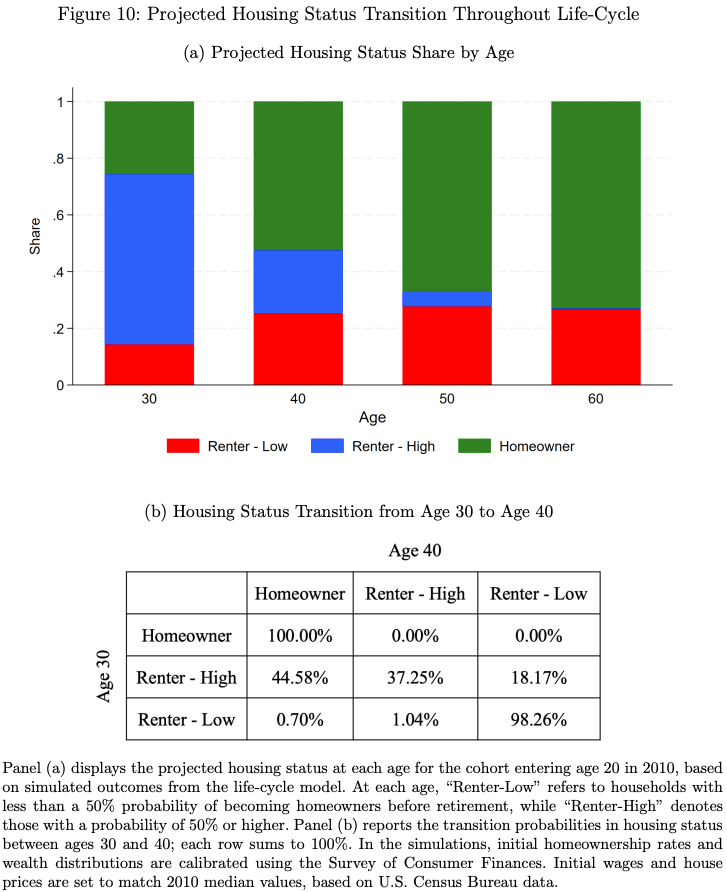
This foreclosure of housing cascades into a foreclosure of the family. Because the bundle must be acquired in sequence, the impossibility of the first step (shelter) halts the progression entirely. We see the wreckage of this halted progression in the broader demographics: The marriage rate has fallen 60 percent since 1970.9 The fertility rate has collapsed to its lowest level in American history.10
The Revealed Preference Trap
The economist’s reflex is “revealed preference.” We infer what people want from what they do. If this young man does not form a family, he must prefer not to. But revealed preference assumes choices are marginal, continuous, and reversible. You can have a little more chicken and a little less beef. Family formation is none of these. It is a discrete choice.
You cannot have 0.8 children. You cannot buy 60% of a bedroom. These are binary thresholds. If your resources fall below the floor required for the bundle, you do not purchase a smaller version of the bundle; you purchase nothing at all.
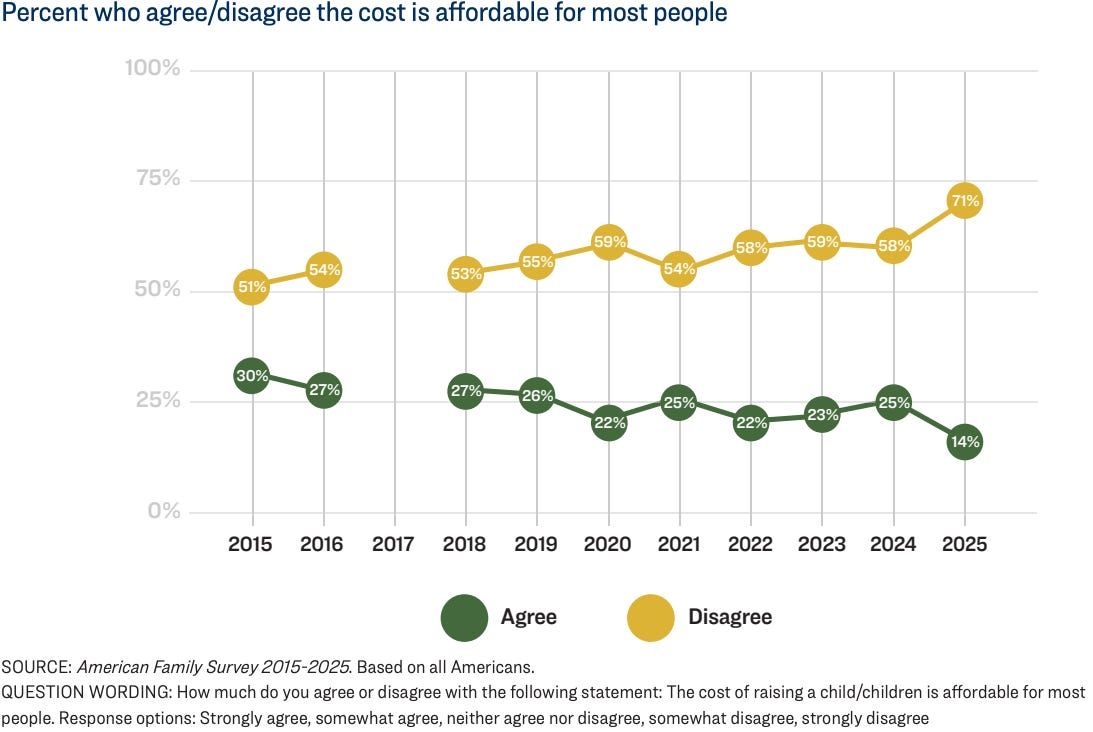
Mounting evidence backs this constraint hypothesis. 71 percent of Americans now say that raising children is unaffordable, an increase of 20 percentage points over the past decade.11 This concern has risen sharply even among the affluent. Concern about the cost of raising a family rose from 33 percent in 2023 to 55 percent in 2025 among households earning more than $80,000 per year.12
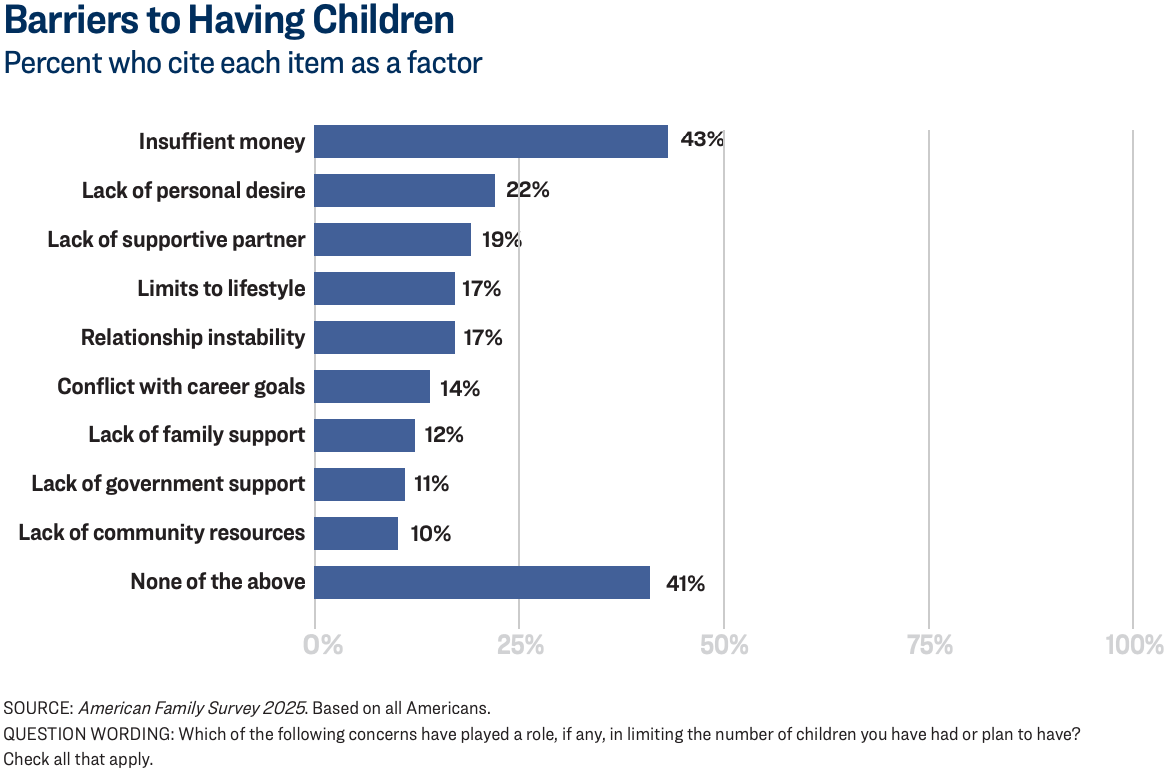
Among the youngest cohort (ages 18 to 29), fully 50 percent cite insufficient money as a reason they have limited or will limit the number of children they have.13 Half of young America is telling us, explicitly, that they cannot afford the families they want. Meanwhile, the BLS reports that inflation is running at 3 percent.14 The economy, we are told, is strong.
III. The Bundle: Two Americas
A functioning family requires a bundle of goods that must be acquired roughly together: housing, childcare, healthcare, a career that can service the debt required to access the career, and proximity to the labor market that offers that career. Each component has, over forty years, risen catastrophically faster than wages.
But the catastrophe is not uniform. There are two Americas: the major metropolitan areas where the jobs are concentrated, and everywhere else.
The Major Metros: Where the Jobs Are The highest-paying jobs in America cluster in roughly twenty metropolitan areas. For ambitious young people with $150,000 in student debt, these metros are not optional. They are where the debt can be serviced. But the cost of entry is prohibitive.
In the economic engines of the country (San Jose, San Francisco, Los Angeles, and New York) the income required to afford a median home now ranges from $236,000 to over $450,000. This leaves median earners with deficits of 40 to 60 percent.15161718
The “Move to Tulsa” Failure Perhaps, the economist suggests, the solution is geographic arbitrage. Move to a cheaper area. This objection fails because it assumes high wages and high costs can be unbundled. They cannot.
Because student loan debt is fixed nationally, moving to a lower-wage market like Tulsa often results in lower discretionary income despite cheaper housing. The arbitrage is an illusion.
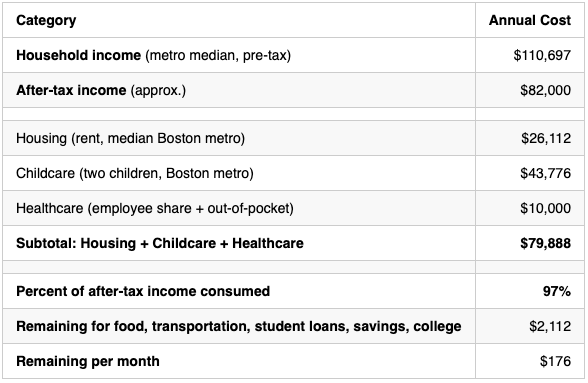
The Arithmetic of Impossibility Let us look at the raw arithmetic for a dual-earner family trying to raise two children. The following tables contrast a family in a major metro (Boston) against the National Median.
Major Metro Family (Boston)
National Median Family
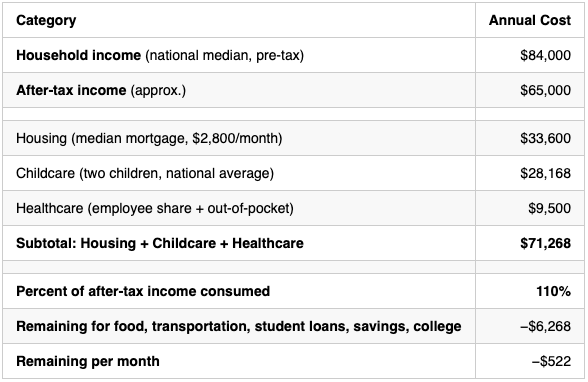
The median American household cannot afford the bundle. The median Boston household can technically cover housing, childcare, and healthcare, but has $176 per month remaining for food, transportation, student loans, clothing, and savings. Spread the budget on the autopsy table and the corpse twitches only once: when you subtract the numbers from the paycheck and the remainder is negative. This is not thrift; it is a forensic demonstration that the American promise is mathematically dead on arrival. The middle class is no longer ‘stressed’; it has been proven, line by line, to be a ghost that cannot pay for its own haunting.
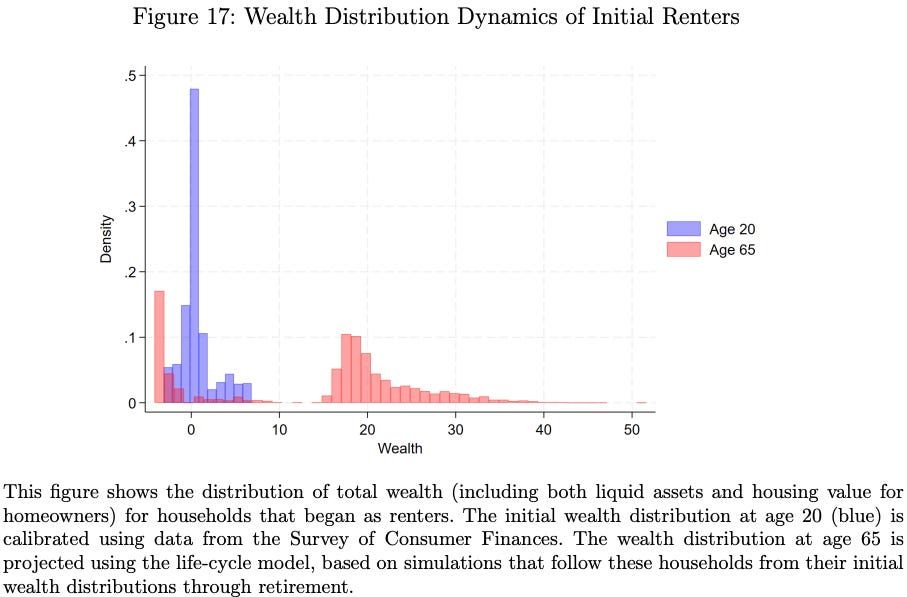
This bifurcation creates a permanent wealth schism. Simulations of the current housing market reveal a devastating “bimodal” future. Those just below the affordability threshold fall into a “zero-wealth trap,” consuming their income because saving is futile. The middle class is not just shrinking; it is mathematically bifurcating into a landed gentry and a permanent renter class.19
IV. The Substitution Methodology
How did this collapse become invisible to official statistics?
The CPI measures the change in the cost of a “basket” of goods over time. But the basket is not fixed. When beef prices rise and consumers switch to chicken, the BLS recognizes that “roughly equivalent utility” has been maintained at a lower cost. You have substituted. You are, officially, fine.
This adjustment is methodologically sound for marginal consumption choices. It breaks down for large, discrete, irreversible life outcomes. The BLS cannot capture the substitution of a two-bedroom apartment for a three-bedroom house, because it tracks housing costs by unit, not by square feet per family member. It cannot capture the substitution of one child for two, because fertility is not in the basket.
The methodology is suited for consumers. It is unsuited for reproducers. Consider the substitutions the statistics miss:
The Nihilistic Substitution The CPI assumes that if a consumer cannot afford a house, they will rationally save that money. The data shows the opposite. When the “Hope Threshold” is breached, savings behavior collapses. Renters with net worth below the median house price spend roughly $100 more per month on non-essentials than homeowners of equal wealth.20 Worse, they substitute safe savings for high-variance risk. Participation in cryptocurrency markets spikes among renters with net worth under $300,000, a phenomenon economists call “gambling for redemption.”21
The CPI sees a consumer buying a nice dinner or some Bitcoin. It does not see a person who has realized the future is a luxury good they cannot afford, and has decided to burn the capital today.
The Geographic Substitution You take a job in San Francisco. Rent is $3,500. You move to Sacramento where rent is $1,800. You commute ninety minutes each way. A price index records that you have found cheaper housing. It does not record that you now see your children only at breakfast.
The Ultimate Substitution You wanted three children. You have one. You wanted a child. You have a dog. The substitution is invisible because there is no price index for the family that never existed.
V. Shadow Inflation: The Unmeasured Costs
Substitution is not the only adjustment that makes the CPI an unreliable welfare proxy. There is also Shadow Inflation:
- Time costs: The modern economy has substituted money prices for time prices. When you pump your own gas, bag your own groceries, and file your own taxes, the money price has fallen, but the time price has risen. The CPI captures the first and ignores the second.
- Administrative burden: A family with a sick child spends evenings navigating insurance bureaucracies instead of reading bedtime stories. This is a cost. It appears in no index.
- Skimpflation: Airlines pack more passengers into smaller seats. This “loss of space” is a deterioration in service that, as economist Dean Baker notes, was “not picked up in the CPI.”22
VI. The Nordic Objection: Floor and Ceiling
The strongest objection to an economic explanation of fertility decline comes from Scandinavia. Nordic countries offer generous supports, yet their fertility rates remain below replacement. If fertility decline were purely economic, shouldn’t Denmark and Sweden be at 2.5?
This objection confuses two distinct claims. 1. Economics is the sole cause of fertility decline. (False) 2. Economics is a binding constraint on fertility. (True)
Think of fertility as bounded by two constraints. The Ceiling is set by culture, the maximum number of children people would have even with unlimited resources. Today, the cultural ceiling has fallen globally. The Floor is set by economics, the minimum income required to have any children at all. Below the floor, you have zero children regardless of your preferences.
The American problem is that economics has raised the Floor above what most families can clear, while culture has lowered the Ceiling. Families are squeezed from both sides. In Nordic countries, the Floor is lower (due to subsidies), but the Ceiling has still fallen.
Evidence for this model is found in the fertility gap. The gap between desired children and actual children is larger in the United States than in Nordic countries.23 Americans face a binding economic constraint that Swedes do not.
VII. The Shadow Economy of Care
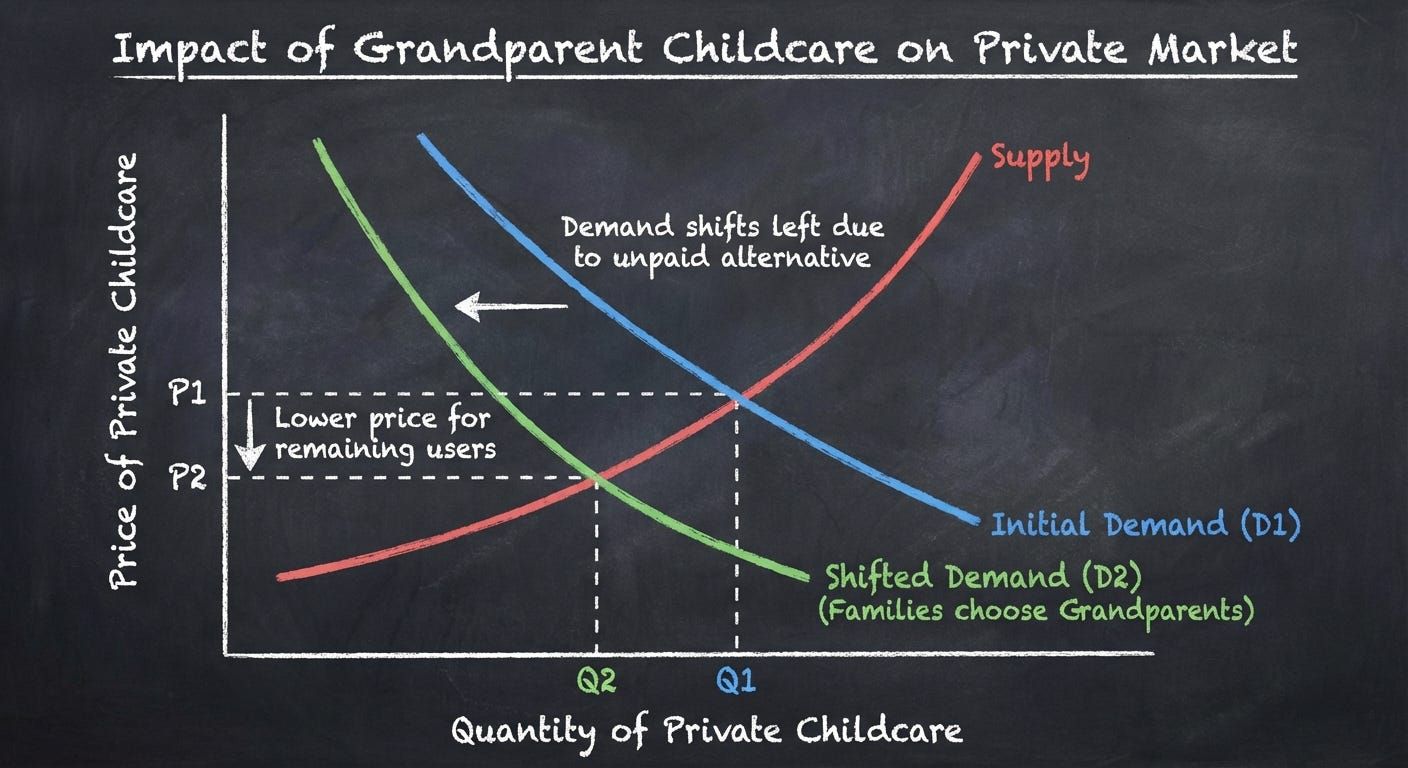
Even families that manage to have children often do so by drawing on resources that appear nowhere in any economic calculation. There is a shadow economy of care that subsidizes the visible economy. One in four children under age five is cared for by a grandparent while their parents work.24
Spreadsheet America records the bargain like this: childcare costs $1,230 per month, Grandma provides it “free,” therefore problem solved. But Grandma is not free. She is spending her retirement. Not her savings, but her retirement itself—the finite stock of able-bodied years between career and infirmity.
Every morning at 5:42 a.m. a seventy-one-year-old widow named Dolores laces up orthopedic sneakers and drives to her daughter’s house so that two toddlers can scream applesauce into her ear while Mommy commutes to the law firm that still won’t pay enough to cover daycare. Grandma is not “helping out.” She is the midnight shift of a shadow factory that manufactures middle-class grandchildren, paid in the currency of her own disappearing sunset. When her knees finally buckle, the assembly line stops—and the country will discover that “free” grandchild care was the most expensive welfare program we never put on the books.
It is tempting to assume these subsidies are outside the economy. In reality, they distort the visible economy. By absorbing demand that would otherwise enter the market, grandparent labor suppresses childcare prices for everyone else. Remove the subsidy, and market rates rise further.
VIII. The Political Economy of the Proxy
Why does it matter that a price index is used as a welfare proxy? Because the numbers are load-bearing.
When the official inflation rate is 3 percent rather than 6 percent, certain consequences follow. Wages can stagnate in real terms while appearing adequate. Social Security cost-of-living adjustments can be minimized. The Federal Reserve can justify policy choices that inflate asset prices.
Some analysts have begun proposing alternative metrics. The economist Oren Cass developed a “Cost-of-Thriving Index” that asks how many weeks a median worker must work to afford a basket of major necessities. In 1985, it took 39 weeks. By 2018, it took 62 weeks.25This index makes visible what the CPI obscures.
IX. Drawing Down the Stock
We are drawing on a stock of family capacity built over generations. The grandparents who provide childcare were themselves raised in larger families with robust networks.
What happens when that stock is exhausted? What happens when the woman who postponed children until 40 becomes the grandmother who is too frail at 70 to provide the childcare that makes her daughter’s career possible? We do not know. We have not been here before. We are liquidating the social capital of a century to prop up the income statement of a quarter.
Return to the young man in his parents’ bedroom. He does not know he is living under a tyranny. He knows only that something is deeply wrong. The official story (economy strong, unemployment low, inflation contained) does not match his experience.
He is not lazy. He is rational. Tell a twenty-seven-year-old that the door to adulthood is now a coin-toss and he does what any rational prisoner does when the parole board walks out: he stops scrubbing the floors. The economy calls it ‘declining labor effort’; the rest of us call it the quiet, lawful suicide of the work ethic. Hope is not a feeling; it is collateral. Once it is foreclosed, the debtor—our entire generation—walks away from the wreck. Why grind for a down payment that moves further away with every paycheck?26
Somewhere in Washington there is an unmarked corridor lined with locked filing cabinets labeled ‘Census of the Never-Born.’ Inside: ultrasound printouts that never fluttered on a refrigerator door, college-saving accounts that never needed opening, lullabies that were never hummed at 3 a.m. No civil servant is assigned to these files; no congressional committee will ever subpoena them. The bureaucrats next door at the Bureau of Labor Statistics celebrate ‘full employment’ while, down the hall, an entire generation of Americans is employed—full-time—in the silent labor of not becoming parents. The archive grows by 1.1 children every woman, every lifetime. Tiptoe past those doors; the hush inside howls louder than the closing bell they just rang at another record for the Dow.
Footnotes
About this Essay and AI Disclosure
This essay was motivated by an article by Michael Green, which made the case that family formation is currently out of reach for a much larger proportion of Americans than one might infer from official statistics. I had the benefit of seeing many top economists’ reactions (for example here, here, here and here) to Mike’s article, so I’ve attempted to both a) harden Mike’s thesis with tight assertions and thorough citations and b) directly address many of the strongest and most pointed objections. I have no illusion that I’ve closed all of the open loops and I look forward to engaging with interested parties in good faith to sharpen the thesis over time.
I also want to be transparent about the AI workflow used to write this piece. Since early 2023, I have refined a process that combines human intuition with the strengths of various open-source and private models:
- Dialectic Ideation: I use separate models to propose a thesis, steelman the antithesis, and generate a synthesis.
- Adversarial Review: Specific agents are tasked with identifying failure modes and logical inconsistencies.
- Deep Research: Agents gather and cite hundreds of sources, which I undergo manual review and AI cross-verification.
- Iterative Drafting: The text is refined through multiple cycles of gap analysis and ‘thesis hardening’ before final publication.
The result is a deeply researched, strictly cited report that leverages the scale of AI execution while retaining human oversight and judgment.
Finally, I acknowledge a profound bias: I am a father. With three children aged 20, 18, and 15, I am personally invested in the machinery of their future. I want to clear the path for them to have it all: the stimulating career in a major metro, the fruitful relationship, the home with a reasonable commute, and the ability to raise a family as large as they choose. It is because I want this so badly for them that I am compelled to document the frictions, costs, and hurdles that currently place this dream out of reach in almost every modern capitalist democracy.
- Gallup, “Smaller Families Are Considered Ideal,” 2023. ↩
- CDC National Center for Health Statistics, “Births: Final Data for 2023.” ↩
- American Family Survey 2025, Wheatley Institute at BYU / Deseret News, November 2025. ↩
- Advisory Commission to Study the Consumer Price Index (Boskin Commission), 1996. ↩
- Pew Research Center, “Young Adults Living with Parents,” 2024. ↩
- Pew Research Center, “Marriage and Cohabitation in the U.S.,” 2023. ↩
- U.S. Census Bureau, “Median Age at First Marriage,” 2024. ↩
- Seung Hyeong Lee and Younggeun Yoo, “Giving Up: The Impact of Decreasing Housing Affordability on Consumption, Work Effort, and Investment,” November 2025. ↩
- National Marriage Project, University of Virginia, 2024. ↩
- CDC/NCHS Vital Statistics, 2024. ↩
- American Family Survey 2025. ↩
- American Family Survey 2025. ↩
- American Family Survey 2025. ↩
- Bureau of Labor Statistics, Consumer Price Index Summary, 2024. ↩
- Visual Capitalist, “Mapped: The Salary Needed to Buy a Home in 50 U.S. Cities,” 2025. ↩
- Zillow, February 2024. ↩
- Redfin, March 2024. ↩
- Redfin, March 2024. ↩
- Lee and Yoo, “Giving Up,” p. 45. ↩
- Lee and Yoo, “Giving Up,” p. 15. ↩
- Lee and Yoo, “Giving Up,” p. 18. ↩
- Dean Baker, CEPR. ↩
- Morgan and Rackin, 2010; Beaujouan and Berghammer, 2019. ↩
- ZERO TO THREE / National Council on Aging. ↩
- Oren Cass, “The Cost-of-Thriving Index,” Manhattan Institute, 2020. ↩
- Lee and Yoo, “Giving Up,” p. 17. ↩