

You hang around any industry long enough and you learn the Rules of Thumb. You succeed in any industry, genuinely or at least in terms of survival, you learn the Rules of Big Toe. For everyone in or around personal finance, we are having one of those moments, right now.
The question is everywhere, and WAY more than normal right now: "Can I retire?" and "How much can I actually take?"
It's not subtle. Media outlets are pounding the question. Advisors are hearing variations of it daily. And the Panoptica Storyboard is confirming it - our "The 4% Rule Works" signature just crossed +202 this week, its highest level in a decade of tracking. A year ago it was at 80. That's not normal drift. That's demand for a specific story.
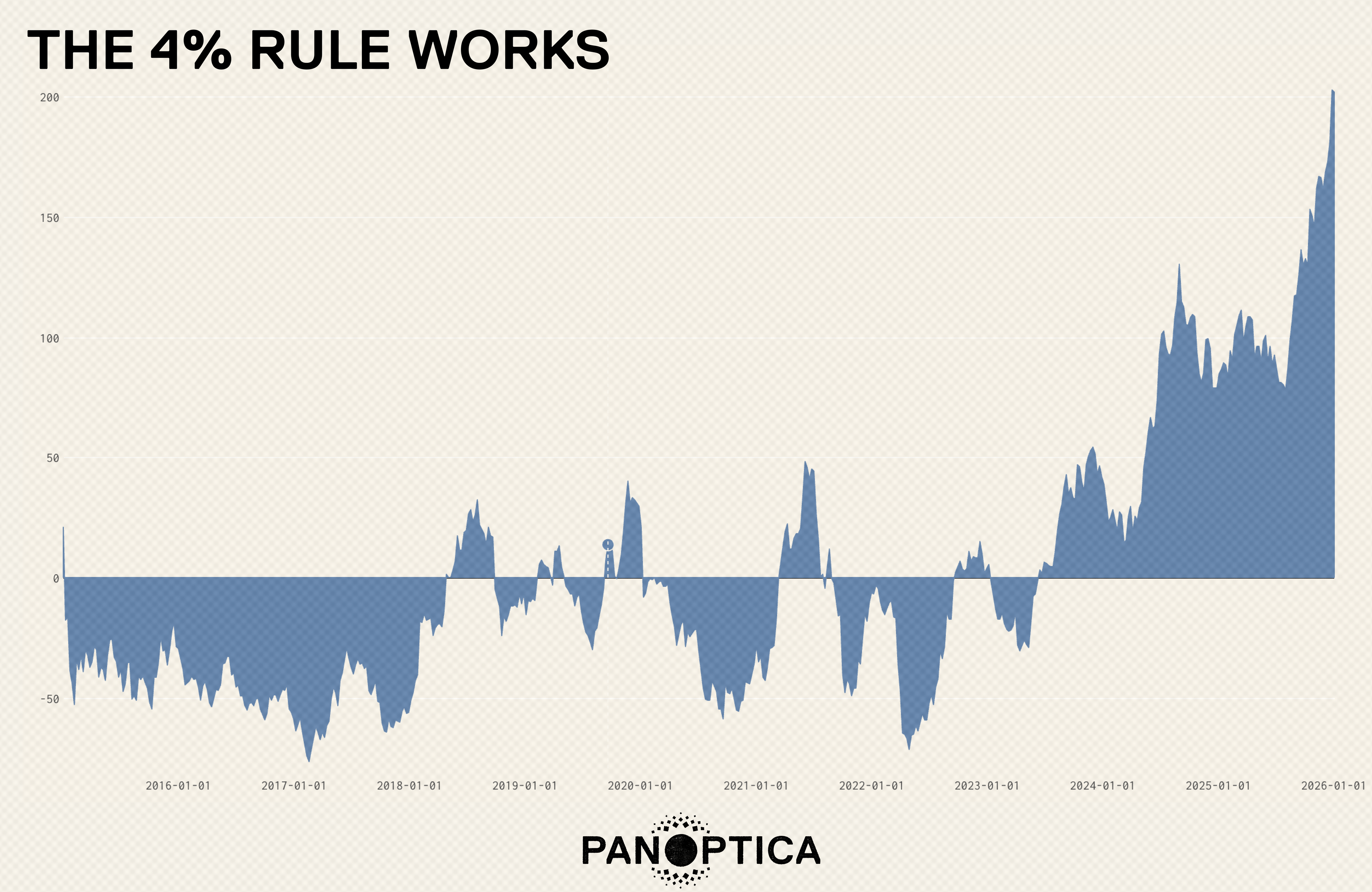
The mechanism feels straightforward. Markets have been rocking for a few years in a row. People are probably checking their account balances and extrapolating. They're calling their advisor asking the oldest question in retirement planning: But how much can I actually take without worrying?
Bill Bengen answered that question in 1994 by stress-testing against: October 1968 (bear market plus inflation), 1929-32 (stocks with a 90% decline), and 1937 (stocks with a 50% crash in one year). He concluded that pulling 4% annually from a diversified portfolio over a multi-decade period, adjusted for inflation, had historically worked pretty well. The idea stuck. It became industry doctrine. Our Bengen interview on Excess Returns landed so hard we had to do a follow-up - the audience demanded more. The conversation is loud right now.
And here's what keeps getting missed, though (from a practitioner’s seat): the 4% Rule is still just a Rule of Thumb.
A Rule of Thumb is inherited wisdom. It's someone else's gathered insights, statistically stress-tested through the lens of their research, passed on for you to borrow without experiencing their pain for yourself. Bengen figured out what worked for his clients. He ran some regressions. It was a great idea. But now everyone is pointing back to his work as proof it'll work for theirs.
You know it. I know it. It’s still worth saying it out loud: The market doesn't care about 1994's stress tests (even if you’ve updated them for 2026).
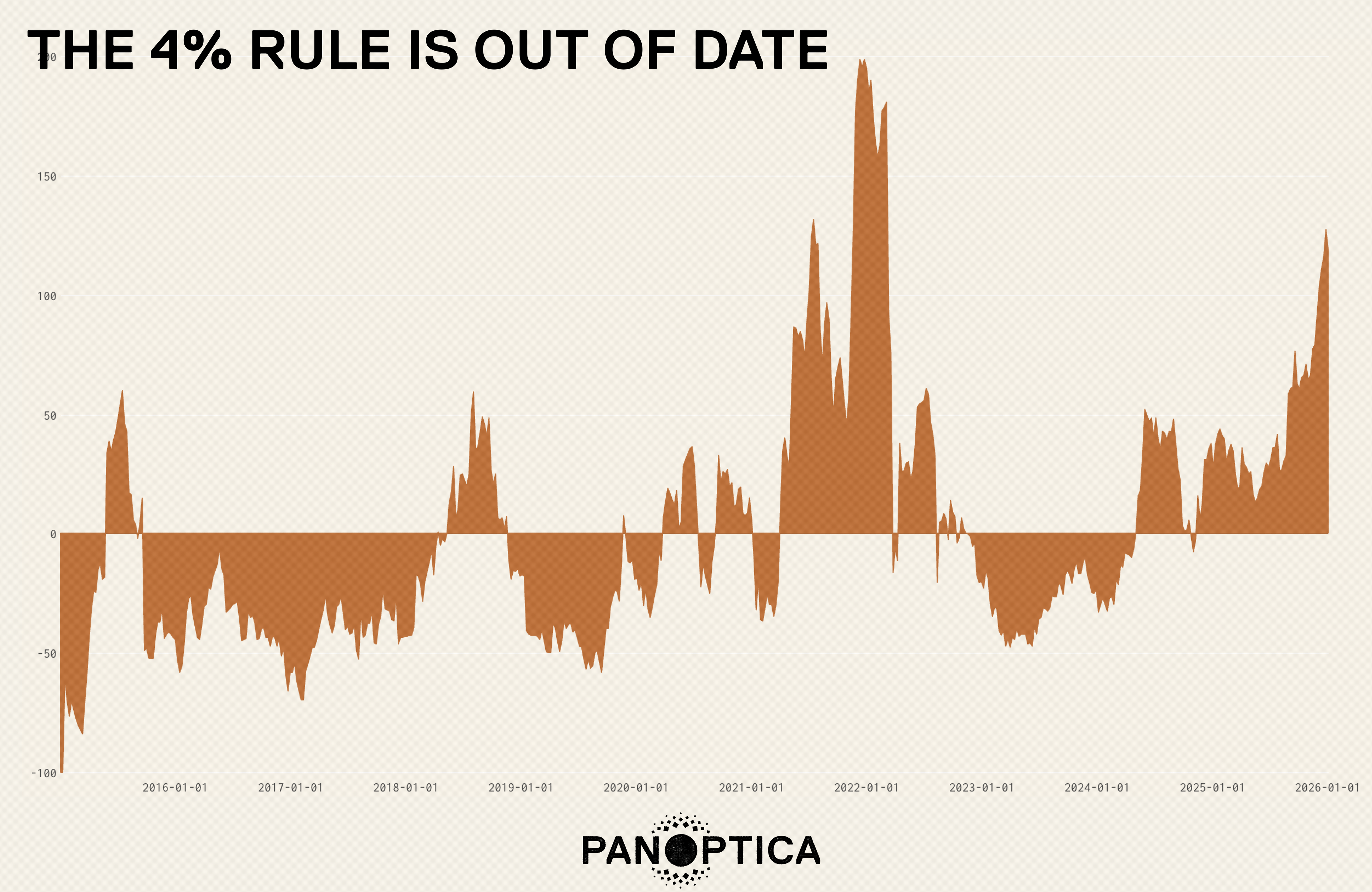
The chart above shows the counter-signal we track, "The 4% Rule is Out of Date," and it currently sits at 114.35. That's elevated, but it's lagging noticeably. You would think it'd be screaming louder right now because the real risk isn't whether 4% worked historically, but if it will work tomorrow, when the portfolio you're withdrawing from is down some scary amount and you're wondering if retirement was the right move.
You know, like in 2022. See that spike in the chart? The 4% Rule was out of date and silly coming out of 10+ great years for the 60/40, right as we headed into the worst year for bonds and stocks at the same time since 1937. The 4% rule's out-of-dateness declined relatively steeply as the year went on and it's longer term merits were re-examined. You should feel free to take a moment to compare the two previous charts now, and think about how all the faith in these planning Rules of Thumb were called into question in 2022.
The strength of these stories is tied to sequence-of-returns risk, and as much as it is an academic problem, it's even more so a deeply personal problem. It's a behavioral one, at its core. If your first year of retirement coincides with a market decline, which is not unprecedented and very, very possible, you're now pulling 4% from a smaller base while locked into spending assumptions. The math compounds against you. The psychological pressure mounts. The Rule of Thumb threatens collapse.
Call it a Rule of Big Toe. These are lessons you've learned the hard way. Legos you've stepped on in the middle of the night. Toes you've stubbed off of bedposts in the dark. Rules of Big Toe are the anecdotes you can point to and say, "I watched this happen." Not "Bengen's research shows X" but "My client did Y, and here's what happened," or "One time I tried Z and I got caught offsides, bad."
That's differentiation. That's real authority. When everyone is pointing to 32-year-old research papers, that's exactly when statistics bite you in the ‘22 caboose.
Right now, everyone is saying "The 4% Rule works." Advisors are spouting the same Rule of Thumb as blog posts and retirement calculators. The spike in the signature is a spike in a commoditized message. And these are the times to stand out. What's your October 1968? What's your 2008? What's your COVID meltdown?
Those answers are Rules of Big Toe. They're harder to defend than a backtest, but that's the point. When it's time for them to matter, those stories will be much more important than a formula.
With market returns so strong and this signature surging, anyone in an advisory role is watching the same thing: everyone is saying "The 4% Rule works" at peak volume. This is the moment where the conversation can go deeper. Not to argue against Bengen, but to ask the real questions, of client's individual lives, that matter most to them specifically.
The market won't cooperate forever. When volatility returns, the advisors who have Rules of Big Toe to point to - lessons learned the hard way, through real client experience - will have something the formula doesn't. You can start building that now, while the data is still screaming everyone else's answer.
Want more? Bill Bengen himself came on Excess Returns and we broke down his ideas as practitioners. And if you want to dig deeper into the Rules of Thumb vs Rules of Big Toe framework, I explored it more here.