

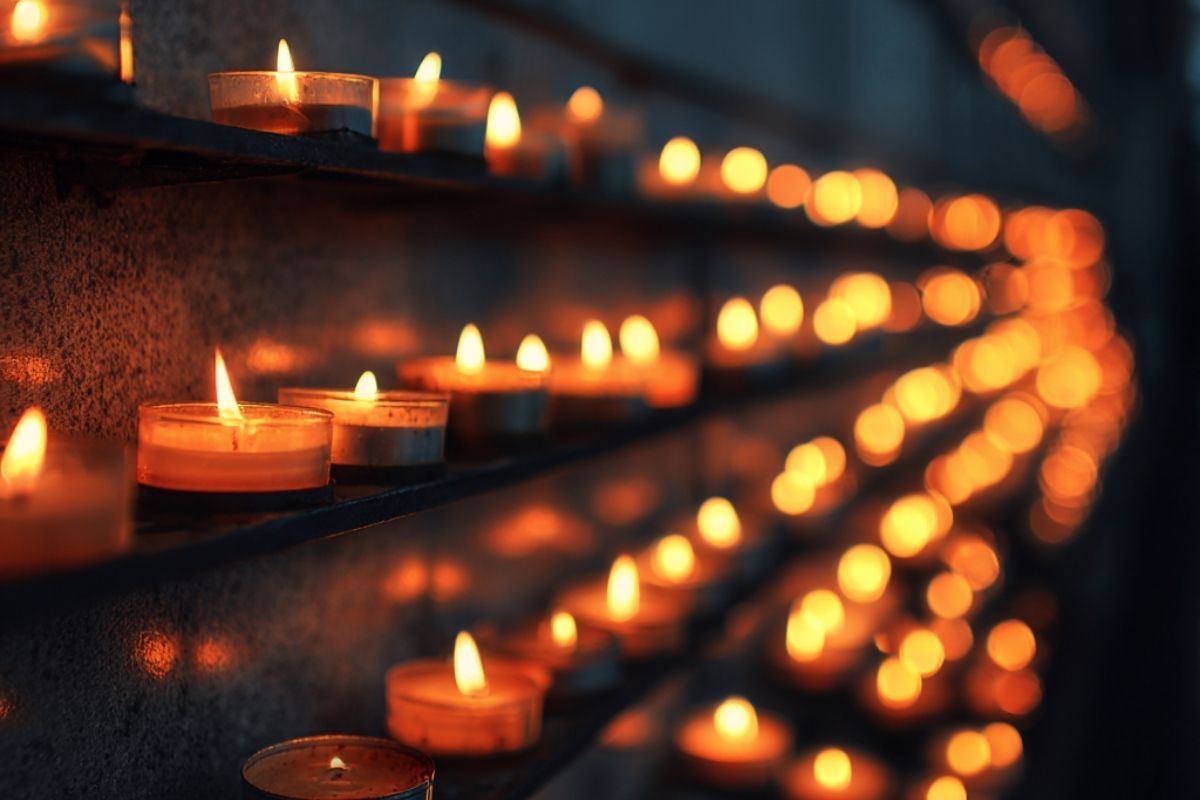
I've spent a lot of time staring at fire.
Being a country kid and now a country adult, campfires have been a lifelong practice. We have a fire pit up on the hillside where, a few times a year, we stack up some wood, grab lawn chairs, a guitar, a bottle. We sing a few songs, tell a few jokes, catch up with friends.
But mostly, it's a Pleistocene group of humans, staring at the fire in silence. The same fire that burns in atoms, suns, gas turbines and get planes. The same fire that makes up the bulk of my meditation and prayer practice life, in a pew or on a cushion.
I don't really know anything about fire in any of it's forms-of-power. I don't wield it or understand it particularly well.
But I know a lot about candles.
---
The candles I love are made of beeswax. They're an inch and a half wide and start about six inches tall. They're easy to come by at farmer's markets in rural New England. Simple column candles.
A candle is a machine. A system that uses and manipulates forces, in this case transforming the excretions of a hive-mind insect system into pure H20, Co2, Carbon, heat and light. (Which is pretty miraculous all by itself.)
There are only two ingredients: the substrate>fuel (beeswax), and the structure (a wick of braided cotton).
When you light a big beeswax candle and just watch, after perhaps 30 minutes, even a perfect, level, brand new candle will have a sooty, galloping, over-hot flame, as more and more wick is been exposed.
Eventually, the heat melts so much wax that it overflows, the flame grows higher, and the structure and the fuel grow out of balance. The wick bends, creating even bigger flames, heat overwhelming the physical stability of the machine. The system collapses, substrate wax left to rebuild into a new candle around a new wick structure, or to use as a prop for Halloween.
While a runaway candle might smell of honey and last year's tomato plants, it doesn't make for a nice, stable, uniform object of meditation. For that, I need to keep the candle-system optimized: fuel and structure in balance.
So. I tend the wick.
It's hardly a "skill." You just have to pay attention. Sometimes a piece of wick will fray or ball up from the too hot fire, signaling it's time to use the sewing snips and maybe a tweezer to trim the wick back to size, so that it can perform it's function as designed: a nice stable flame in the darkness.
Even then, there remains a problem. This now well tended flame may not burn hot enough to melt the wax at the candles edge! And so, carefully and with cautious, oft-burnt fingertips, I push the wax in from the edges, to add more fuel to the system, the rim of the candle bowing in to the flame.
Diligently maintained, a candle like this can burn down to the very last scrap of wick on the plate, without a drop spilt. Small acts - the snip of the structure, the nudge of the substrate, make all the difference. While barely disturbing the system itself, tending the wick guides, with loving attention, the little miracle fire-machine towards it's highest, most efficient, most useful, most beautiful form.
I am aware that I'm not making particularly high impact use of either my time or the energy of the flame. Nor do I make a living from the making of candles or the husbandry of the hives. Perhaps it's enough that it's a a spot of light on a dark journey I take alone each night. Like I said: I don't really know much about the fire.
But I know how to tend the wick. To do what I can to keep the system in balance.
But that's just a thing I know about candles.