

Flipping through the Panoptica Storyboards in the wake of the Super Bowl this week, I had entertainment on my mind.
Between overheard conversations at the local pizza place and scrolling social media, everybody over a certain age seems to be wondering where monoculture went, and everybody below a certain age seems to be wondering what monoculture even is. That is purely anecdotal, by the way, but check your vibes and agree or disagree however you like.
Monoculture is either missed or missing and we're all grappling with what that means, or, at least, how it feels.
On one hand, we all can agree that the internet made us weird(er). It's changed the way we talk and think, it's changed how we ask (and how we Google, and how we query ChatGPT) "who cares." And that latter part especially has changed the way we qualify and quantify our rationale.
Entertainment and attention have evolved. Big time. So as I was browsing through the Storyboards (as you can too!) a few Signatures jumped out at me extra.
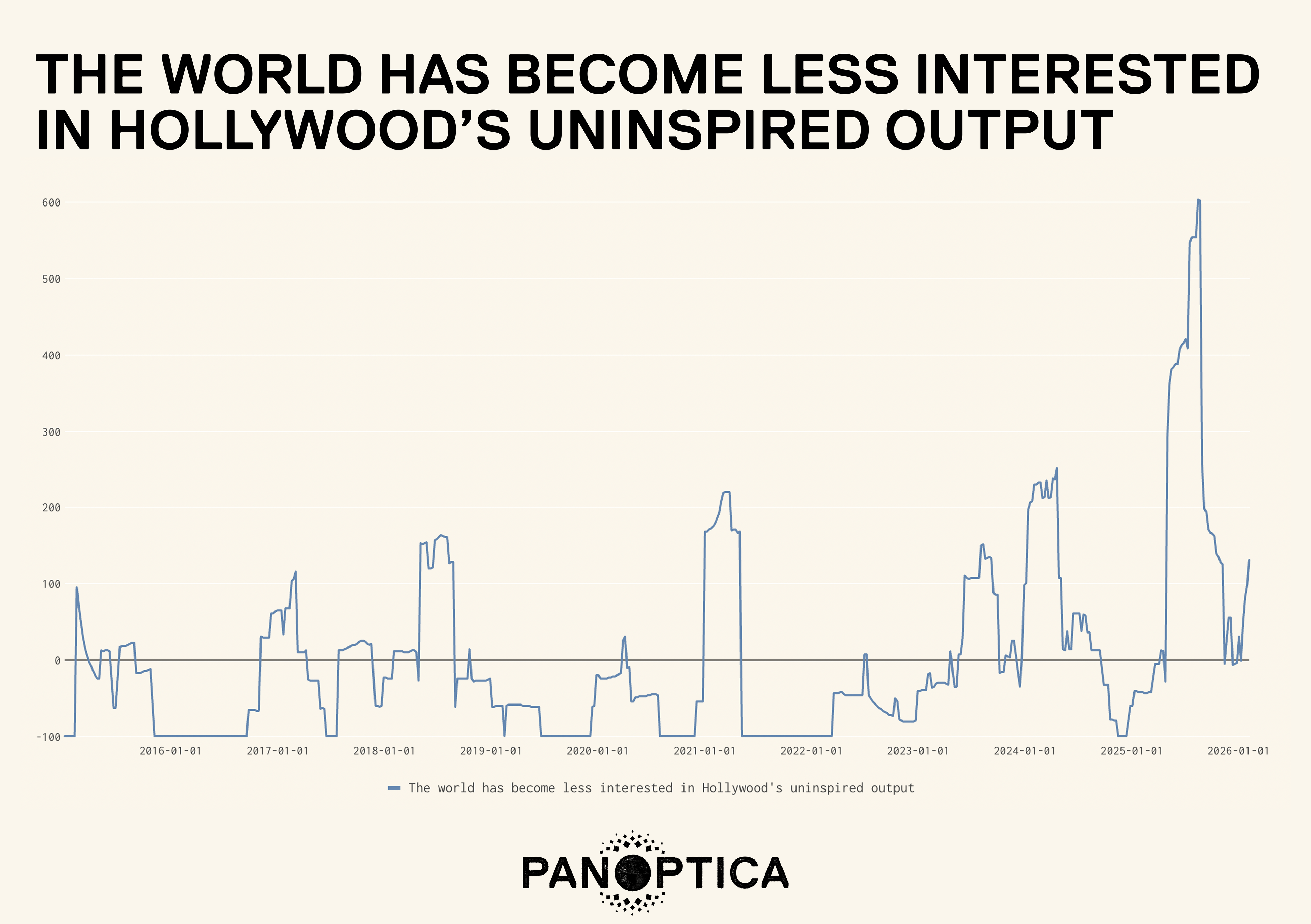
Start with Hollywood. The movie industrial complex hasn't had a massive hit since Barbie in 2023. Something on the order of 50–60 million tickets were sold over its run (no way to figure out repeat viewers, but let's conservatively assume 50–60 million people went to see it). Not that there hasn't been some great cinema in its wake, but this is as close to monoculture as Hollywood's gotten in the recent past. The Panoptica data confirms it. We just don't find it entertaining enough anymore. Look at "The world has become less interested in Hollywood's uninspired output" and note the right of this graphic, at the very quick uptick the Signature is experiencing:
Where is the attention going? We all know sports are a views game on television and now streaming, and that the Super Bowl is supposed to be the great American spectacle. This year didn't disappoint. Nielsen stats estimate how many people are watching at any one point in time, and the big game averaged 125 million viewers. The halftime show did even better, with 128 million viewers for its duration.
I'll do the math for you - that's roughly twice the entire U.S. theatrical audience for Barbie, compressed into a single evening. So, is that monoculture? Or closer to it? Because, back to the anecdotal research at the pizza place and on social media, you may have heard - the halftime show was politically divisive.
If you missed it, President Trump watched Bad Bunny's halftime at his Mar-a-Lago party (not the TPUSA Kid Rock counter-show his people had been promoting for weeks), then went on Truth Social to call it "absolutely terrible" and "a slap in the face to our country." But if even the people marketing the alternative couldn't stomach watching the alternative (or had FOMO about missing the standard event), well hey, that's the state of the entertainment industry in a nutshell.
Maybe chasing mini-culture as THE culture is THE problem. TPUSA wanted their version to represent the American experience, at least as they see it. Kid Rock was there, they had flags and loads of Jesus/Bible/small town references, and lots of talk about "real" America. 6 million people showed up to watch. I think the numbers tell the story but I'll put some words on it - they tried that in a small town and got a small town's worth of viewers.
Contrast that against Bad Bunny, who put a spotlight on a small island as part of a much broader system. "Together, We Are America" was his closing line. He celebrated mini-culture without demanding it become THE culture. 128 million people stayed for it. A 21x Kid Rock multiple. And Bad Bunny came out, just as committed to do HIS thing. The 31-year-old streaming phenomenon gave you raunchy lyrics, a traditional marriage proposal, Brooklyn bar culture, Puerto Rican pride, sugarcane fields, and a proper stadium spectacle for the halftime history books. He didn't sand off any edges to make it palatable, he didn't complain. He just put it all out there, very creatively, and let people take what they wanted.
The difference here can't just be political coding. Don't let them reduce it to that for you. The difference is whether you're trying to force your mini-culture to replace everyone else's as a monoculture. One halftime show tried that, the other didn’t.
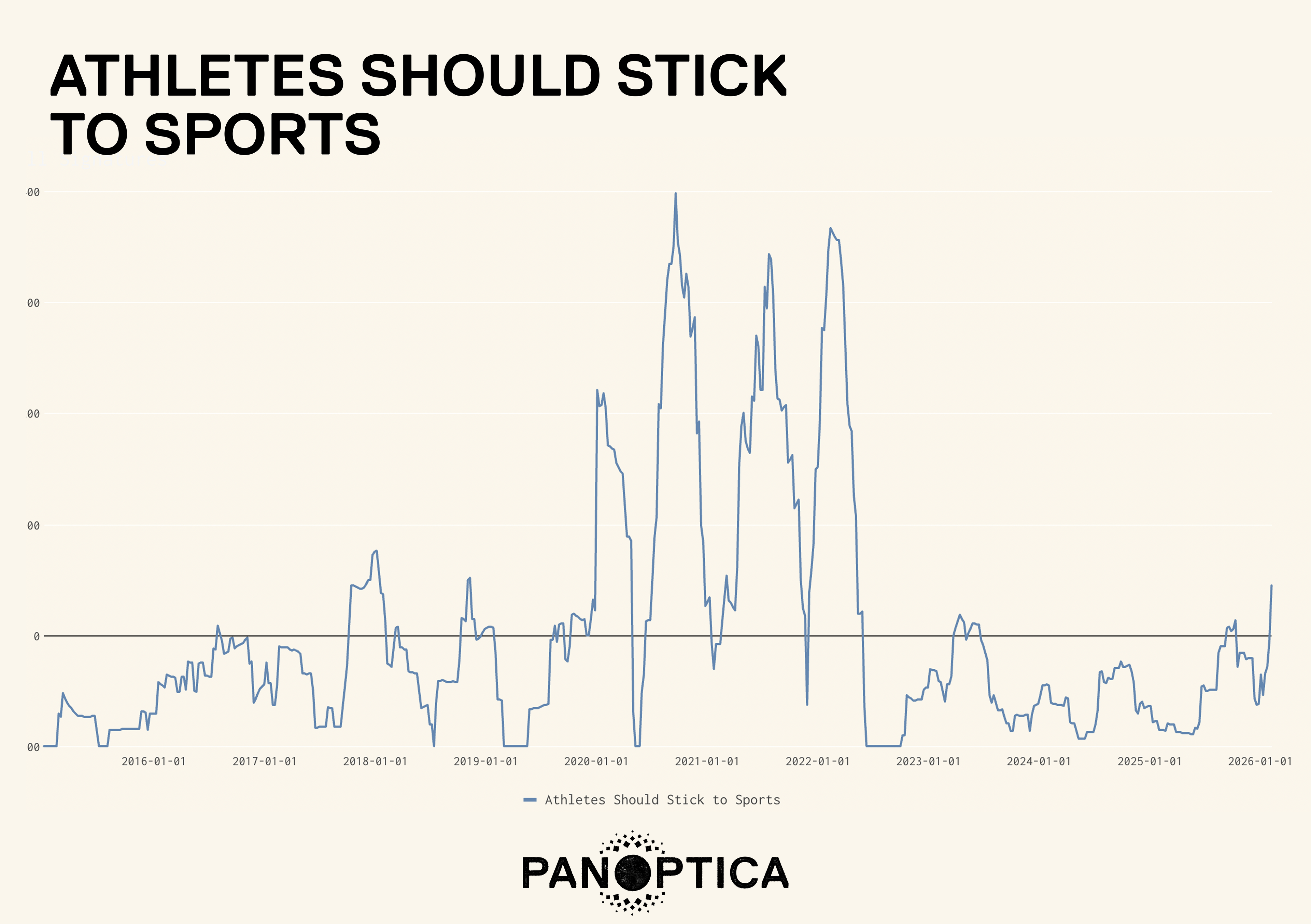
But let's think about the people who care about politics in sports for a moment, too. Because we hear that, and you can treat entertainment as a proxy, even if it's not a perfect match. When we look at the Signature "Athletes Should Stick to Sports" - note how it's surged in the past four weeks:
We're also seeing "Athletes Have a Platform and Should Use It" really start to jump back up in the same window:
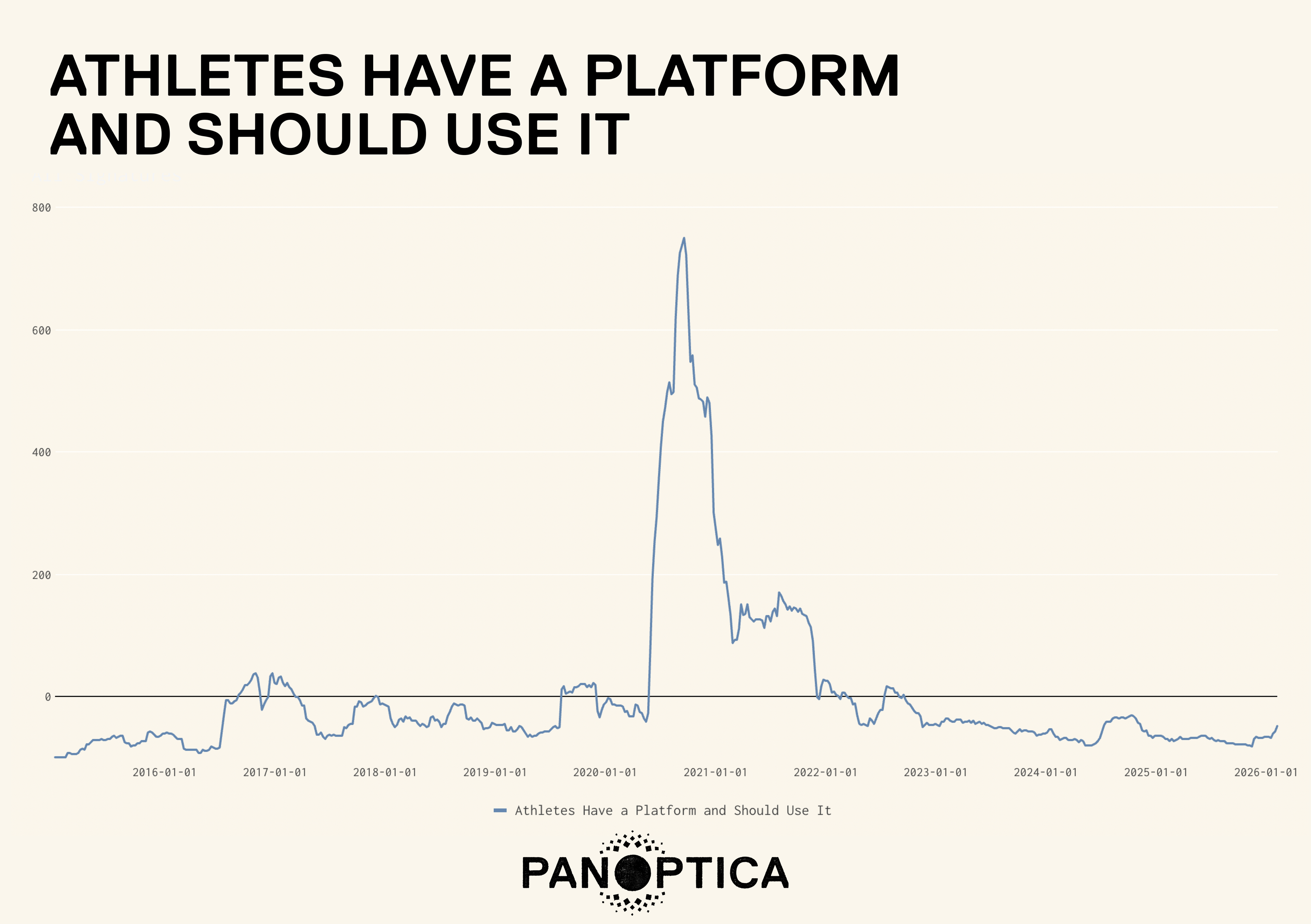
Part of this is the Super Bowl, but a bigger part is Winter Olympics coverage that's everywhere right now. Athletes have been vocal. We've definitely had headlines about some U.S. competitors speaking out about Minneapolis ICE shootings and domestic politics. Given media tactics in our modern era, any time you have people holding flags with mics in front of their faces, media outlets want to catch a controversial take. The Olympics are also an explicitly global event, and therefore about as close to globally monocultural as it gets.
This is why even Trump watched Bad Bunny despite promoting Kid Rock - you have to go where the audience is if you want to be associated with the Zeitgeist (pun intended). But the wider question growing in my mind as I browse through these Storyboards, is how far gone our prior sense of monoculture is and how it's not coming back - globally OR nationally. We're either going to figure out how to reconcile all of these mini-cultures or we're not, and the decision to make a mini-culture the new mono-culture is not the positive way out of this.
I have to take it back to the halftime shows. When you think about how each approaches the lack of monoculture in entertainment, TPUSA's answer was their mini-culture or nothing declaration. The Bad Bunny answer, conversely, was his team’s mini-culture celebration, nested within the context of co-existence.
People want to be entertained. Some people just want something to be angry at, too, but let's focus back on a smaller level, at how we make entertainment entertaining again. We aren't getting it from Hollywood. We are - in small instances - getting it from sports when sports goes big, like the NFL did this year (even if the game itself was a dud), and opts to put a celebration of the mini-cultures that make up the teams, the fans, and the future of the league on the line.
It was brilliant. It was beautiful. Let the numbers speak for themselves.
Monoculture is dead. The internet killed it, it’s time to stop mourning it. Instead of fighting for which mini-culture should be the new main culture, take a page from Bad Bunny's halftime show.
Yes, that means it’s ok to get a little raunchy, but also, it means be nice to your elders while you're partying, and if Lady Gaga wants to show up, just roll with it. And most of all, it means celebrate the mini-cultures. You might have to learn something about them first, but do it! Then, don't be afraid to be surprised AND laugh a little at the strangeness of new details as you uncover them, and have a little fun with it.
Because that's what entertainment does best. It pulls at our curiosity until it captures our attention. And when we're truly entertained, we learn something about others, at the same time as we learn something about ourselves.