
Warner Bros. pulled off a miracle this summer with Sinners. It was the first original screenplay to cross $200 million domestically since Pixar’s Coco in 2017. Animated films have a much wider audience than a movie about vampires in the South who like to tap dance to delta blues, so that’s not really a benchmark. To find the last live action original that hit that milestone, we would have to go all the way back to Gravity in 2013.

Michael B. Jordan and Miles Caton in "Sinners"
This is the same studio that also gave us One Battle After Another, a powerful story about the dance between revolution and false hope, Weapons, a phenomenally successful horror film that also happens to be an allegory, among other things, for how we treat school shootings in the US, and close to a billion dollars in revenue with an I.P. staple like Minecraft. And yet they were just acquired by Netflix, although we can expect some intense regulatory hurdles ahead, or at least I hope so.
Media consolidation, especially in the form of oligopoly, has been accelerating for over a decade, so this is not surprising. What I find concerning is that this feels like the consolidation of imagination itself. When a legacy studio taking creative risks gets absorbed into a platform optimized for second screen viewing, we need to wonder what happens when we lose the narratives that challenge us to think differently, and with them, our capacity for the kind of engaged attention that sustains civic life.
Netflix pioneered content engineered for distraction, asking writers to assume viewers would be on their phones while watching. Their habit of trusting the algorithm over artistic intuition was on full display with Season 2 of Squid Game. It gave executives what they desire most, views, but generated zero cultural traction, and they still turned it into a reality show. Why wrestle with critiquing late stage capitalism when you can gamify it, profit from it and generate social media likes instead. The critique became the product, and consuming it made us forget what the critique was for in the first place.
Why does it matter? Should people not just watch what they want, whether that is Sinners or Love Is Blind. To answer that, I would like to channel the man who sent us a warning long before algorithms began shaping our subconscious. David Foster Wallace.
In an interview with Charlie Rose, he described television as his “main artistic snorkel to the universe.” Turns out that our greatest artists are always reacting to and learning from the culture they consume. In the best cases, those artists produce work that helps us understand each other more, as well as the time period we're living in.
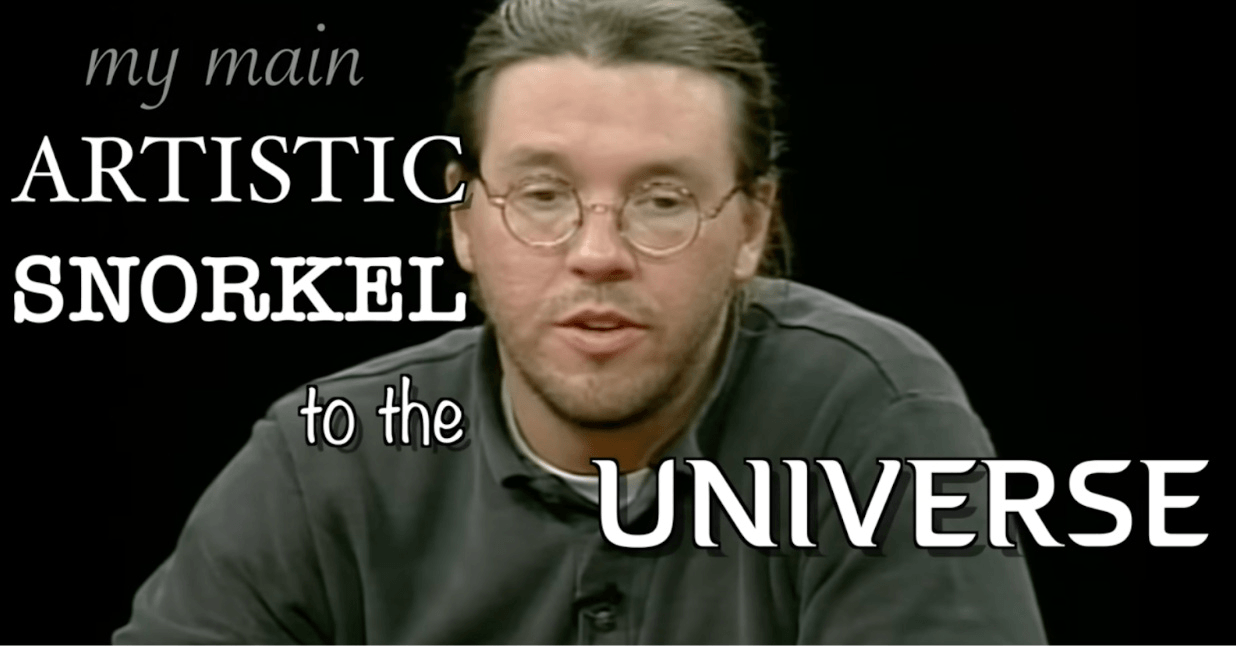
Now imagine Wallace's snorkel running through the current algorithmic flood of comfort content, sustained by a business model that cannot justify appealing to the higher selves within us. What would our artist breathe in? What kinds of stories would they be inspired to tell, and to whom?
Chloé Zhao fell into this trap before she realized she could not stay in that world. After making the ethereal Nomadland and winning the Academy Award for Best Director in 2021, she was pulled into the vortex of the algorithmic and I.P. driven machines and gave us Eternals, a film both the audience and the studio would love to forget. The assumption that return on investment is the only measure of value dismisses the public’s capacity for deeper cultural or introspective discussion. Now that Zhao has stepped back into her own lane, she has given us Hamnet, a film about grief and art that premiered at festivals to rave reviews, and is poised to compete for major awards.

Jessie Buckley and Paul Mescal in "Hamnet"
This essay will not stop the oligopoly. Neither will antitrust regulators. Show business runs on viewership metrics and always will. But what we consume matters. The market for depth still exists. We still seek stories which appeal to our humanity even as we consume cultural fast food that rarely nourishes our inner lives. It is essential to seek out work that sparks the conversations we need to advance the most pressing questions of our time.
And thankfully, within the very platform that perfected distraction, we have a reminder of what that can look like. Stephen Graham's Adolescence is a bone chilling show about the impact of social media driven envy and jealousy on a group of teenagers, anchored by a central character who commits murder. It became the third most watched Netflix series of all time and sparked an urgent conversation among parents, young people, and schools around the world about how the platforms built to connect us are tearing apart the social fabric of teenage life.
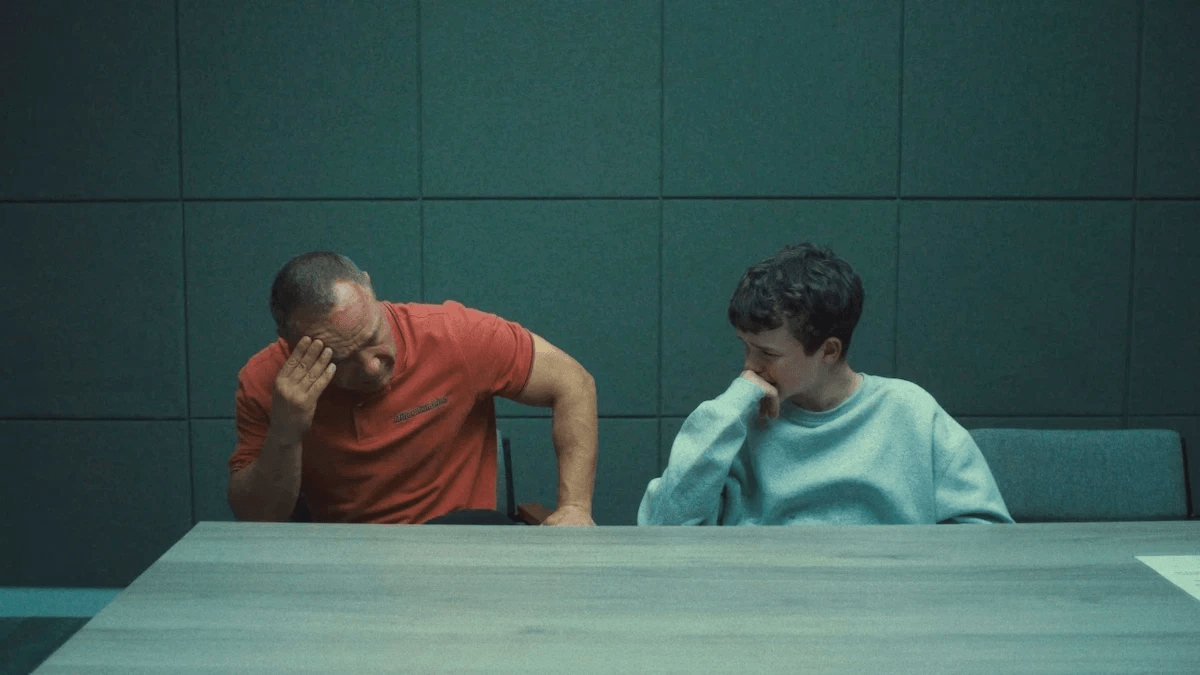
Stephen Graham and Owen Cooper in "Adolescence"
The stories that make us confront our reality are the ones that nudge us to change it. If we are left only with stories that make us comfortably numb to our reality, we invite a world that metastasizes into an intellectual complacency that keeps us stagnant and, in extreme cases, blind.
There was a time when Dead Poets Society encouraged young men toward sensitivity, creative rebellion, and intellectual courage. I still remember when The Matrix came out, and how it reshaped an entire generation's view of reality, questioning systems, perception, and the nature of freedom, a story inspired by Plato's Allegory of the Cave. Culture is built on collective human reflection of the shared stimuli we consume. When our stimulus comes from age old myths, great novels, or thoughtful political rhetoric, we inherit a stronger psychological and philosophical scaffolding to make sense of our world. And when the dominant stimulus is comfort, culture responds accordingly.
There has always been a balance between the Hollywood blockbuster and serious cinema, between comfort and contemplation. In 2019, all of the top ten highest grossing films were either sequels or I.P. extensions, and most of us would struggle to name even one. The film we do remember from that year is Parasite, a story that turned out to be eerily prescient about class, inequality, and how the flood eventually reaches the penthouse. Weeks after it won the Oscar, the world went into lockdown, and the metaphor became impossible to ignore. It was a story that gave us something to talk about and helped us make sense of our collective listlessness in that moment.
The question I keep returning to is what happens when that balance disappears. What happens when the cultural conversation tilts so far toward comfort that the stories capable of stretching our imagination no longer reach the buoyant level that Sinners just did. And what is the net effect of losing the conversations we are no longer having as a result. What does a world look like when the holiday dinner question, “what are you watching,” never leaves the shallow end of the pool, producing the same tired titles, the same halfhearted nods, and the same polite “I will add it to my list,” which everyone knows is code for “can we move on to something more interesting.”
Sinners became the first movie in over a decade to turn that kind of profit because the creators tapped into something we are all feeling. The essence of the story is a young boy being pulled in three directions, all of which promise transcendence: his father's church, the seductive pull of vampires with Irish and Southern accents, and music. He chooses music.
It tapped into our collective need for new pathways to transcendence. Because beneath all that doom scrolling, we are all looking for a way to connect with something deeper. Let us not ignore that yearning. Start by choosing what moves you, instead of accepting the pull of monolithic institutions and soul sucking feeds. The boy did. So can we.
Rohan Routroy writes at Nothing In A Nutshell, where he explores the world through the lens of myths, movies, and meaning.